Showing posts with label The Internets. Show all posts

Thursday, July 02, 2009

Why the Marburger Plan to Save Newspapers Won't Actually Save Newspapers

Yesterday we looked over the so-called Marburger proposal to allow newspapers (and presumably other content providers) to sue news aggregators for unjust enrichment. Since that post I've seen a couple others talking about monopoly of information, so I say again -- the Marburger plan would only protect reporter work product, not the information itself. If a reporter can obtain the same information independently, the cause of action should fail. (Accent on should -- the Marburgers do not entertain the possibility that the cause of action will drift and morph beyond what they envision, but that's another post.)

Before we get started on the problems with the proposal, a couple of caveats. First off, what I know about the newspaper business is what I read. Same with some internet use patterns. The difference between what lies below and what the Marburgers have done is that I have paid attention to things they haven't. Again I restate my central objection -- the Marburgers prove propositions with thought experiments that should be tested with data.

Finally a couple of links that got left off of yesterday's post. First off, Editor and Publisher covers the proposal, but with no critical comment. New media guy Marc Cantor weighs in with ideas about what the newspapers themselves can do to maintain an audience. (h/t Brewed Fresh.) A piece from the UK looks at the Marburger plan in the context of the far more draconian proposal from Judge Richard Posner to give papers intellectual property rights over their links. And if you really wanna get geeky wit it, here's a Coase Theorem treatment of the Posner idea. There has also been more dogpiling on Connie Schultz from various blogs. You can look through the links in yesterday's post and extrapolate if you really want to see more of that sort of thing.

Now on to the show.

Marburger Cures the Wrong Disease.

My biggest objection to Marburger (for want of another name, this is what we'll call it) is that it assumes that the gravest threat to newspapers is losing readers. While papers have lost readers steadily throughout the Twentieth Century due to competing media (radio was killing off papers long before the internets) the precipitous drop in revenues has happened on the advertising side.

Advertisers have been migrating steadily to online sources that have nothing to do with newspapers. This is particularly true of classified advertising which has traditionally been an indespensible revenue stream for newspapers -- up to 70% of profits. Craigslist has done the most damage, but Monster, Cars.com and for that matter Ebay have all taken away business that newspapers once dominated. As a result, classified revenues have dropped by half since 2000. Analysts like Lauren Rich Fine (that's the source of the 70% figure) have been warning for years that newspapers cannot survive ad revenue losses of this magnitude.

Online classified services offer advantages that newspapers cannot match. If you are paying for a newspaper classified, you are subsidizing that news gathering operation whose expense the Marburgers so persuasively described. Your cost is based on total circulation, despite the fact that only a tiny percentage of those readers are likely to have any interest in your ad. With online classifieds, on the other hand, every pair of eyes that wanders into the site is at least in the market for something along the lines of what you want to advertise. No one goes onto Cars.com to read about Michael Jackson's kids. They go to buy a car.

(By the way I have a theory that computer-based advertizing is a general danger to both content providers and content consumers. Advertizing is generally really inefficient. Again only a tiny percentage of whoever sees an ad has an interest in the subject of the ad. As computerization allows greater targeting, advertizing becomes more efficient. The more efficient it is, the less businesses have to buy it.)

Marburger does nothing about the loss of classified advertising. By their admission, they are talking about marginal increases in traffic. But traffic doesn't matter if it doesn't attract advertizing.

Curing the Wrong Disease, Part 2 -- Problems in Monitizing Websites.

The Marburgers would no doubt object that online ad pricing is dictated by traffic, which is true. But its not like newspaper website advertising was profitable, then the profits started to erode due to unfair competition from aggregators.

The fact is that it's really difficult to sell enough advertising to support web-based journalism. There isn't as much real estate on a web page (versus print where, among other things, you have facing pages that don't have an analog online). And people can block ads. And web advertising is still working to overcome a past rife with charlatans (remember the commercial about the poor sap who shot the duck in the banner ad?)

And of course news organizations are competing with sites that allow better targeting (see above.)

Over time, changes in technology may make monitizing online content easier (the rise in video allows commercials that you can't fwd past) or harder (written content on mobile web allows pretty much no space for ads). But between the loss of advertizing to other providers and the basic difficulty of paying for journalism with online ads, the newspapers are facing an inevitable decline that tinkering with intellectual property will not fix.

That said, the free rider effect that the Marburgers identify is the sort of thing that lawyers should seek a remedy for. Whether the Marburgers have correctly identified that effect and whether their proposal would provide an adequate remedy is another question.

Wednesday, July 01, 2009

Jeff Fusco Is Canvassing

Count City Council at-large candidate (and Citizens for Akron Treasurer) Jeff Fusco among those getting a jump on the very very crowded field for Council this year. I didn't see him in my neighborhood but got a flier stuck in my door. Fusco is one of three at-large candidates, along with Terry Albanese and Jim Shealey, whom Mayor Plusquellic is endorsing in the race.

I've been scrying the internets for council campaign sites. Fusco is one of the few I've found. I'll start a roll at left for them. Fusco is simply using Blogger as a platform for his site, but is keeping the blog updated (ahem, Sandra Kurt). Bare bones to be sure -- he didn't even spring for a non-blogspot url. But it still puts him well ahead of the pack in terms of web presence.

At large incumbent Jim Shealey has a personal webpage up -- one that got him some criticism when he linked to it on his Council page. It's not exactly a campaign website but not exactly not either.

I have three or four projects in mind for the blog this summer. Sifting through the Council candidates is one of them. If you know a candidate -- or are a candidate -- feel free to touch base.

Tuesday, June 30, 2009

The Marburger Proposal to "Save Newspapers" Round up and Initial Thoughts

Connie Schultz began what is rapidly becoming a national conversation about the economic future of newspapers with her Sunday column about a proposal by the brothers Marburger. Daniel is an economist at Arkansas State University, David is a partner at Baker Hostetler who represents newspapers, including the PD.

You can find a pdf of the proposal on the "blog" version of the column.

The default blogger reaction has been to hate on this mercilessly. Of course any time Connie Schultz ventures anywhere near blog world, Tim Russo's melon explodes, so the Marburger plan has taken over #JamesRenner among Russo Trending Topics. But other negative reaction has been nearly as intemperate from Jeff Jarvis, Anastasia at ODB, Mediactive, you get the idea. Some reaction has been a bit more measured and some has been borderline positive, but overall, it hasn't gone well.

I also have problems with the proposal, but since the haters have had their vein-bulging, spit-flying fun, I will try to break things down a little more soberly. Not as much fun, I know, but the proposal raises real issues that merit serious discussion. And let's face it, I'm generally the wet blanket at the hater party.

So. Let's start with what the proposal is. And isn't.

Aggregation Aggravation.

The Marburger proposal takes aim at news aggregators, in particular those they call "parasitic aggregators." The Marburgers begin with the assumption that some news aggregators summarize and rewrite reporting from online newspaper sites, and by doing so skim some would-be visitors to the site that did the actual reporting to put that information online. Whether this actually happens is highly questionable, but let's leave it for now. I know you want to stop and yell and scream about strawman scenarios, but seriously, let's lay this out before we pick it apart.

The problem is that copyright protection traditionally protects expression, not information. So while it would violate copyright to simply reproduce news stories verbatim, it does not violate copyright to write up the information into a new story.

So assuming aggregators are actually taking eyes away from newspaper site, they are doing so using the work product of newspaper reporters. The Marbugers spend a large chunk of their 51 pages making the case that because doing journalism is labor intensive and expensive and aggregating is relatively cheap, that aggregators work at a comparative advantage that will eventually drive newspapers under.

While the argument that aggregators are cheaper to run than news sites is well-established, the authors also claim that the loss of traffic to aggregators is a big reason newspapers cannot monitize their website traffic. This part of the argument they extrapolate from their talk of aggregators. It is entirely data-free. Indeed, to preview one blanket criticism of the paper, the authors engage largely in thought experiments to establish propositions that should be testable by examining actual data.

The Unjust Enrichment Solution.

In the early days of the teletype (1918) the AP successfully sued to prevent a competitor from rewriting its stories and selling them to newspapers. The case went all the way up to the U.S. Supreme Court and according to the Marburgers (I haven't researched it directly yet) won under a theory of unjust enrichment pursuant to what was then called Federal common law. The Court has since declared that there is in fact no Federal common law and that instead, a Federal court not deciding a case under a Federal statute has to choose some state's common law under which to decide. Bear that in mind when we talk about problems with the proposal, a post or two down the line.

Unjust enrichment is a well-established common law doctrine. Basically it means you can't profit from someone else's work. In law school we mostly study it under contract law. If two parties do not agree to a contract but one mistakenly starts doing work, the party that profits from that work can't refuse to pay because the contract wasn't finalized.

After the AP case, the particular strain of unjust enrichment enshrined there was referred to as the "hot news" doctrine. Importantly, the doctrine limited the use of information contained in a "hot" news story, but did not prevent enterprising reporters tipped off by a story from going out and doing their own reporting on it.

Problem is copyright law is a federal statute and federal laws generally preempt state laws. During a 1980s rewrite of copyright laws, Congress explicitly stated that state law remedies for copyright violation are preempted; copyright is the exclusive remedy for violations.

The Marburger proposal reverses that decision. Copyright law would be rewritten to allow state law claims for unjust enrichment. The individual states would then thrash out what constitutes unjust enrichment, what the remedies are and so forth. While commentators have called it an expansion or tightening of copyright, it isn't. It is more of copyright-plus regime, where the plus is the "hot news" unjust enrichment doctrine.

The Marburger proposal is neither benign toward First Amendment freedoms, nor the total squelching of those freedoms some critics have claimed. It is not the information land grab some have predicted, but it does expand rights to control of information under very limited circumstances. In sum, the proposal will benefit newspapers and put some burdens on other content providers, though the extent of those burdens would have to be hashed out in court.

Given the problems/burdens attendent in the proposal, my biggest problem with it is that it will not work. We'll take that up in the next post.

Thursday, June 04, 2009

Casino Petitioners Caught Loading the Dice

Got a presser today calling out the Ohio Jobs and Growth Committee (i.e. the hundred somethingth attempt to legalize casino gambling in Ohio) Folks working against the issue (yes, including some adjacent-state casino interests) caught some petition circulators erm bluffing a little with the facts. And caught it on video and posted it.


The Mahoning County Dem Party has filed for a temporary restraining order to stop the Committee from circulating petitions.

The video gives a good picture of how this sort of thing happens -- including the celebrated case of ACORN. The guys in the video don't look like they've read the same briefing book about which lies to say. They look like guys who are paid by the signature and say anything to get voters to sign on the line that is dotted.

As someone opposed to legalized casino gambling I enjoy seeing a little mud splashed on those who insist on inflicting this issue on us every election cycle. As someone interested in how campaigns use online tools, this is an interesting case study (about 500 views so far. Meh.)

But mostly it's the lawyer in me that will be watching this with fascination. While the evidence doesn't support a vast conspiracy to lie to potential signatories, it does point to bad training and bad quality control. So what will the judge do about that? I've been told that the judge will decide the case shortly. Wait and see.

UPDATES. The judge in the case issued a temporary restraining order on June 5. The pro-casino group moved the court to vacate the order and dismiss the action on June 9.

Tuesday, March 10, 2009

Anti-Recall Site Launches.


Citizens for Akron
, the official political committee countering Warner Mendenhall's recall effort err the entirely spontaneous grassroots recall effort that Warner Mendenhall is selflessly donating his time to launched their website today. They are still building it as it launches, so if you get a "site offline" message, just hit refresh.

From an online tech perspective, they are doing this thing mostly right. The site launch was announced via Facebook message. On launch the site includes a support form that allows users to sign up for emails or texts. There's also the now de riguer feature that allows people to create "accounts" though at this point it's unclear what one would do with an account. (Though to their credit, they haven't tagged it "MyCitizensforAkron.")

And of course lots of info. At this point the site content is tilted toward what a cool guy Plusquellec is and arguments that a recall at this stage is a dumb idea. The tough choice for the organizers will be whether to counter the accusations leveled by the recall folks. The site promises itself to be a work in progress and so will be worth watching.

Thursday, March 05, 2009

State Recoverydotcom Sites: How Blue They Are.

Researching yesterday's post about state recoverydotgov sites, I was curious about whether there is any pattern to party affiliation and putting up such a site. Since SocialGovernment proprietor Alexander Muir has already done a bunch of the legwork on the state sites, I asked him about it in his comments section. His project isn't about party quibbles so he politely declined to name the trend but did offer some useful resources.

Namely two maps. One from Recoverydotgov's national office showing which states have their own websites:


And one showing party affiliations of governors:

And he invited me to reach my own conclusions. Which would be that of the 16 states that have put up websites, only one - Missouri - none has a Republican governor.*

Republicans opposing the stimulus package was a principled stand. With all the cleavages on social issues and foreign policy, the one constant in Republican thought are the convictions that government spending is bad and tax cuts are the only effective economic strategy. I didn't say it was a sensible stand, but it is a principled one.

But while voting against stimulus may have been principled, petty acts of defiance to undermine it are not. The Obama administration has included transparency provisions in the stimulus legislation and is encouraging states to use tools on the internet to effectuate that transparency. Republican governors may think spending-based stimulus is a bad idea, but unless they are Limbaugh pods, they should want the money to be spent on actual things, rather than wasted. Democratic governors are trying to use the internet to that end; Republicans by and large are not.

And it's not just the admittedly chimeric goals of transparency and public participation they may be thwarting. There's also work to be done to protect their citizens. For example, Ohio Attorney General Richard Cordray has launched a public information campaign warning homeowners to beware of scam artists pretending to be part of another (Republican hated) Obama initiative, the housing market stabilization plan. It will be interesting to see how many Republican states fail to take that common-sense step.

Republican state officials who pretend the Obama initiatives have nothing to do with them don't simply serve the Limbaugh "hope he fails" agenda, they also misserve their constituents.

*Edited thanks to Anthony in comments.

Wednesday, March 04, 2009

Anti-Recall Group Hitting the Internets

Citizens for Akron, the political committee that will oppose the recall effort that is now gathering signatures, has established at least the beginnings of a web presence. A website is currently sporting a placeholder page admonishing visitors "Don't sign it" with a promise of more to come and the official disclosure tag.

A less official Facebook group has now launched -- within the last day or so I would guess from the growth rate. It has gone from 16 members to over seventy just today. Unlike the website, it doesn't have the disclosure/treasurer notice and in fact Jeff Fusco is no where to be seen.

Little to no info on either so far, but the race is just beginning.

Watching Ohio's Recovery.Gov

Like a number of states, Ohio has set up a state version of the Obama administration's Recovery.gov, offer the promise of Web 2.o interactivity with the stimulus bill. The website/blog SocialGovernment offers an assessment of various state efforts, opining that Illinois has the best. Ohio's isn't metnioned (Ohio has yet to merit a mention on SocGov, generally btw), but Ohio's appears close to on par with the apparently gold standard Illinois site.

The reviewer/blogger Alexander Muir on SocGov graded Illinois highly on "interactivity" -- the website tools that allow users to communicate with the government recovery workers. Ohio has two of the same tools as Illinois -- a form for submitting proposals and another for submitting questions generally. I'd give Ohio extra points for including a feedback/question form on the FAQ page with the promise to post answers to questions submitted. An FAQ based on Questions that are actually Asked Frequently is in itself a welcome throwback.

As Muir notes, the real test will be online transparency as projects are selected and shovels start digging. I'm particularly interested in seeing how much of the decision-making process we will see online. And as is true with pretty much any website, it looks good when shiny and new, but the real test is whether the web team can keep it updated and fresh.

H/t to Governing Mags' 13th Floor blog.

Wednesday, October 08, 2008

"That One" Is 2008's "You Forgot Poland"


Presidential debates are like open wheel auto races: The participants have little contact with each other making them generally dull, but the crashes are spectacular if they occur. And mercifully, they go by pretty fast.

But as tedious as debates generally are, they do occasionally contribute some few bytes to the popular culture data stream. This cycle, the contribution seems destined to be John McCain referring to Barack Obama as "that one." If I have found the last person in the Western Hemisphere who hasn't seen it yet, here is the clip:


I'm less scandalized by this than some. More than anything I find it curious to hear John "Western Maverick" McCain using what I always considered to be a mid-Atlantic colloquialism. I never heard it before my stint in the DC area, but there it was pretty common. And people generally used it affectionately but teasingly, rather than coldly dismissively.

I haven't been able to verify it's origins as "that one" is pretty much impossible to Google. Someone with a better working knowledge of linguistics blogs than I (*cough* K-Pho *cough*) may be able to help out with this.

In any event, just like "You forgot Poland" was up and viral within hours of the '04 debate, some enterprising souls have thatone08.com up and running, complete with merch. (H/t Dave Harding at ProgOH.) And because this is 08, not 04, we also have a Facebook page.

Tuesday, September 09, 2008

Plain Dealer Among Papers Teaming with Politico

From Editor and Publisher:

    Politico, the online political news site, has launched a new content sharing network that will provide news items to other news outlets -- including several newspapers -- in exchange for ad placements on their sites, the Web site revealed Tuesday.

    In an announcement, Politico states that it has partnered with Adify, a vertical ad network management company, to launch the Politico Network. Through the new venture, media organizations selected by Politico editors will have access to the site's top stories for use online and in print.

    "The Politico Network also brings a new revenue model to these media partners: Politico will sell national advertising to be placed on partners’ websites, and revenue from those ads will be shared between Politico and the media outlets," the release stated.

    Among those news outlets already signed up for the network are The Atlanta Journal-Constitution, The Philadelphia Inquirer, The Denver Post, and The Plain Dealer in Cleveland, Politico stated.
In fairly short order Politico has become a journalistic force, though who knows how the economics look. The received wisdom at the time of launch was that Politico needed a viable print counterpart to survive. This may be a way to accomplish that.

News organizations are working on all sorts of content/ad revenue sharing models as the economics of news gathering shift and tighten. The value of an outfit like Politico is that it can serve multiple segments simultaneously. They report the deep minutiae for us political junkies, but can synthesize that into more reader-friendly stories for normal people.

Tuesday, August 12, 2008

CNN Expanding News Ops to C-Bus

Reuters is reporting that the cable news channel is expanding (it sounds more like decentralizing) its news gathering operation into twenty new cities, including Columbus. From the article, it sounds like this is not a bureau in the traditional sense, but something new and tech-driven:

    CNN will hire a handful of new employees, while reassigning some current employees to new jobs. The goal is to have a mix of traditional network correspondents and what CNN calls "all-platform journalists" or APJs, who gather news using lightweight kits that include laptops, cameras and editing tools for Internet as well as on-air programming in all 20 cities.
As both a news consumer and an aspiring content provider (not necessarily to the CNNs of the world, but generally) this sounds like a potentially exciting development.

Interesting h/t for the story. I've been on Twitter for about a month now. As you stay on the service, media organizations that Twitter begin to "Follow" you basically as a means of proclaiming their existence. Today I got notice that something called CAMediaGuide was following me. Clicking through I found a news aggregator with a horrible design -- a rejected-by-Matt-Drudge level of horrible -- but some useful content. Not interested in California, but more clicking revealed an Ohio Media Guide. Still borderline unreadable on screen, but pretty useful as a Twitterer. So I Followed and got the tweet this afternoon.

It took a long time to warm up to Twitter, but so far it has been a useful tool.

Wednesday, June 25, 2008

New Nanosite Takes on Dobson's Take on Obama

Yesterday Dr. James Dobson, one of the most influential evangelical opinion makers, dusted off a 2006 Obama speech about faith in the public sphere and trashed it. Today God-o-Meter notes that a nanosite (remember them?) is up: James Dobson Doesn't Speak for Me.

Named as an organizer is one Rev. Kirbyjon Caldwell, pastor of a Houston megachurch. While Rev. Kirbyjon has been on the O Train from early in the cycle, he is also a friend of W. Bush. So the Reverend is probably left of center politically, but not someone likely to be painted as another Jeremiah Wright.

The site features a good side-by-side of Dobson's remarks and what Obama actually said. As of now if a transcript of Dobson's rant is available it's hard to locate, meaning you have to listen to all 18 minutes of it which, no thanks. But based on the JDDSFM website, it looks like most of what Dobson objects to and calls undemocratic or inimical to his freedoms is a wild misreading of what Obama was saying. Check for yourself.

Friday, May 23, 2008

The Rise of the Nanosites?

TechPres riffs on two new "nanosites" set up to answer the question "Is Barack Obama a Muslim?" This one simply says NO, while this one gives the same answer with some links. Perfect for anyone who can't do better than take him at his word.

Nanosites, as I glean from the TechPrez article, are simple, generally one page and convey a compact message. TechPrez notes that lately they have generally called to action. But reading all this brought to mind the first microsite to cross my radar:

The day after the first 2004 debate K-Pho emailed, asking in the subject line "How long does it take to set up a website?" The answer was a link to You Forgot Poland, a brilliant Bush satire, mostly in Photoshopped pictures. A quick Google search pulled up YouForgotPoland.org, something of a micronostalgia site in which the original creator offers the story, the images from the site, the backstory, and of course, the opportunity to buy a T Shirt. (The answer to K-Pho's question apparently is two hours)

Returning to the topic of nanosites as political campaign tools, the TechPrez post wonders aloud how effective something like IsBarackObamaMuslim can be against a viral email. Dunno and we'll find out. It certainly does offer a quick and easy way to send an email of one's own, (not to mention a blog post.)

Friday, April 11, 2008

Community WiFi Coming to Akron

The ABJ's lede today is the announcement that Akron will host a "wireless internet access corridor" under a plan unveiled yesterday. The Knight Foundation is granting $4.5 million to the nonprofit digital networking organization OneCommunity to set up the network. OneCommunity will set up the Knight Center for Digital Excellence to run the network. In addition, the Center will be part of a broader effort to expand community wireless access. This from the press release:

    The nonprofit Knight Center of Digital Excellence will collect and
    share international best practices online with communities everywhere. It
    will provide on-the-ground aid to the Knight communities to develop
    technology strategies and enable citizens to connect with each other and
    the world. Knight's initiative includes a $10 million Digital Opportunity
    fund offering challenge grants to Knight communities.
In addition to the seed money from the Knight Foundation, both the City of Akron and the University are pledging money to operate the network.

You can watch the press conference on Knight's site. Case Wester CIO and blogger Lev Gonick blogs about the presser here (h/t BFD. Gonick is also a OneCommunity co-founder.)

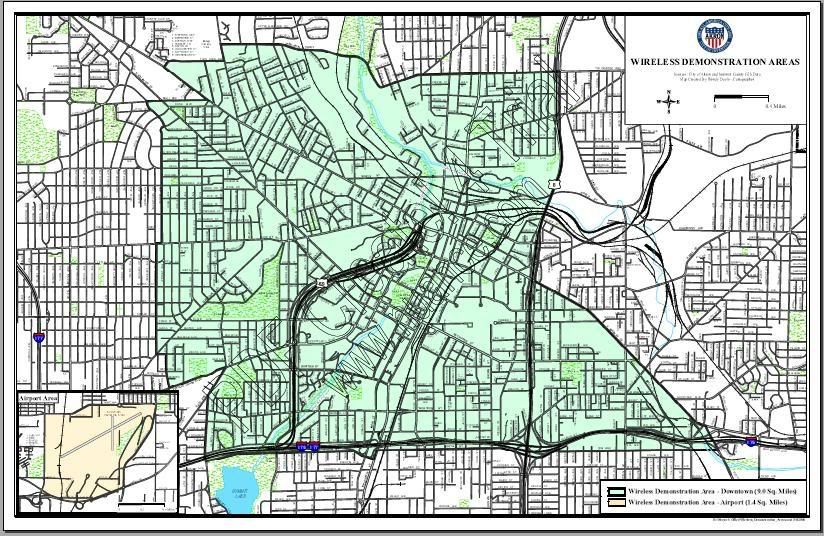
Ohio dot com hosts a pdf map of the area to be covered. With less functionality, we offer this:

This is very much about central city with a clear focus being business development. The area is bordered roughly by Memorial Parkway/Tallmadge Ave on the north, Route 8 and Exchange Street on the east, South and Fifth streets on the south and Mercer and Storer Ave on the west. While plenty of residential areas are included, much of what is excluded is residential. Most of the wealthiest (Northwest where the rubber mansions stand) and poorest (especially Summit Lake) areas are just beyond the coverage area.

More thoughts later.

Friday, February 08, 2008

State Sen. John Boccieri Launches New Website

The new url is JohnForCongress and the site looks nice. Good toolset including sign-ups for house parties and an events calendar. Links to Facebook and MySpace pages. A lot of the usual stuff, but well done all in all. Separate pages for news clips and blog posts.

I don't envy campaign web masters these days as the difference between a feature being cutting edge and de rigeur is about week and a half these days. Team Boccieri is pretty much on top of everything.

Friday, January 25, 2008

Electricity Deregulation and Net Neutrality

I took in the Press Club panel about electricity deregulation or re-regulation or whatever they end up doing. Depending on how the weekend plays out, I may or may not post comprehensive summary of the program. But one quick line from the day deserves close attention.

The essential issue is whether it is possible to create a genuinely competitive market for electricity. Everyone agrees that because of the particular qualities of the electricity market, creating a competitive market means more than just lifting regulations, it means ensuring that a number of conditions are met.

According to the panelist from First Energy, one of the sentinel qualities of a competitive market is open access to transmission. That is, each competing provider must be allowed access to the lines to the homes of electricity customers. And that makes sense. The market can't be competing grids, it must be competing providers on one grid, even if one of the competitors owns the grid. Remember, this is the industry

Which is exactly what net neutrality advocates argue for. A truly competitive market for internet content must allow free access to transmission. With cable and phone competing, we have a less ironclad monopoly of the end of transmission, but we have the same barrier to perfect competition -- companies seeking to compete can't simply put up a new transmission grid. If the market for internet services is to remain competitive, content providers must have open access to transmission.

Arguments against net neutrality tend to use "regulation" as a boogeyman and/or argue by metaphor. That's smart tactically because in fact net neutrality regulation seeks to preserve a status quo that has worked pretty well so far. Up until now, net neutrality was guaranteed mostly because the technology didn't exist to allow network owners to discriminate based on content.

Now the technology is coming on line and network owners appear increasingly inclined to use it. Recently the usually prostrate FCC bowed to pressure and is investigating allegations that Comcast is blocking peer-to-peer traffic. And AT&T is considering monitoring traffic, purportedly to block protected intellectual property. In fact the move makes little sense except as a pretense to dismantle net neutrality.

Sometimes progressives favor regulation because we believe a competitive market brings unwanted side effects. But this is a case where regulation is needed not to blunt the effects of competition, but to ensure that the market remains truly competitive.

Monday, November 19, 2007

Young Americans Reading Less

This seems like at least an annual event -- a study showing that Americans -- particularly the up and coming generation -- aren't reading. Today the National Endowment for the Arts released a meta-study examining data from the U.S. Department of Education and other sources finding that leisure reading is declining, especially among late-teens and twenty somethings. The guts from WaPo:

    The NEA reports that in 2006, 15-to-24-year-olds spent just 7 to 10 minutes a day voluntarily reading anything at all.
Bad, but here's what's really disturbing:
    It also notes that between 1992 and 2003, the percentage of college graduates who tested as "proficient in reading prose" declined from 40 percent to 31 percent.

Here's how it's happening:
    The percentage of 9-year-olds who say they "read almost every day for fun," the NEA report notes, rose slightly, from 53 percent to 54 percent, between 1984 and 2004. During roughly the same time period, average reading scores for 9-year-olds rose sharply. But the percentage of 17-year-olds reading almost every day for fun dropped from 31 percent in 1984 to 22 percent in 2004, with average reading scores showing steady declines.

That, by the way, tracks school proficiency data generally. American kids are generally doing well in K-5, then start to lose their way in middle school and lag behind peers in other countries in high school. And why is this happening? We can't say definitively it is the obvious culprit, but:
    Iyengar emphasized that the NEA's data can show correlations but cannot prove a causal relationship between reading decline and, say, the proliferation of electronic media.
The other obvious discussion point is -- what of the internet? The NEA has been criticized in the past for not acknowledging online reading. Two problems this go round. First, the decline in reading proficiency is a problem no matter what the platform.

Second, electronic communications in the late 2.0 era are less conducive to practicing reading -- and writing for that matter. This Slate story confirms what I've been noticing; that kids are not surfing and emailing so much as IM'ing, chatting and texting. The latter are basically electronic versions of verbal conversation, not actual writing and reading of what anyone would call prose. A couple friends of mine teach remedial writing to college students. They have found it necessary to teach their students that it is not acceptable to spell "you" as "u." OMG its FUBAR. Thz kds CUS.

BTW, I don't remember who to h/t -- Publisher's MarketPlace dropped it in their Lunch email, as has area blogger Keith who suggests the solution is more David Drake. At least one other non-primary source referenced it. I tip my hat to you all.

Tuesday, November 06, 2007

Internet Usage up to 80%

According to a new Harris poll:

    The survey, which polled 2,062 adults in July and October, found that 79 percent of adults -- about 178 million -- go online, spending an average 11 hours a week on the Internet.

    "We're up to almost 80 of adults who now are online, or are somehow gaining access to the Internet. That's a pretty impressive figure," said Regina Corso, director of the Harris Poll.

    The results reflect a steady rise since 2000, when 57 percent of adults polled said they went online. In 2006, the number was 77 percent.
The page on Harris Interactive includes plenty of additional data, including this tidbit -- 97 percent of those who use computers are now internet users as well, also an all-time high.

Saturday, September 29, 2007

YouTube Opens "Nonprofit Program"

Online video sharing megalith YouTube is opening a program that offers advantages to nonprofits using their site. From AP via Ohio dot com:

    Hundreds of nonprofits currently leverage YouTube, the leader in online video, to raise awareness of their causes. Today at the Clinton Global Initiative, YouTube announced the YouTube Nonprofit Program, a way to make it even easier for people to find, watch and engage with nonprofit video content on the site.

    YouTube's 2007/2008 Clinton Global Initiative commitment enables nonprofit organizations (in the U.S. those with 501c3 tax filing status) that register for the program to receive a free nonprofit specific YouTube channel where they can upload footage of their work, public service announcements, calls to action and more. The channel will also allow them to collect donations with no processing costs using the newly launched Google Checkout for Non-Profits. YouTube's global platform enables nonprofits to deliver their message, showcase their impact and needs, and encourage supporters to take action.
Participating nonprofits get:

    -- A premium channel on YouTube that serves as a nonprofit's hub fortheir uploaded videos. Through the channel, people can connect with a
    nonprofit via messages, subscriptions, comments and more. Nonprofits will
    also receive enhanced channel branding features and increased upload
    capacity.

    -- Designation as a "Nonprofit" on YouTube that clearly identifies
    organizations as a nonprofit for YouTube community.

    -- The ability to embed a Google Checkout donation button on their
    channel and video watch pages, allowing people to quickly and securely make
    a contribution directly from YouTube. Starting today, nonprofits who offer
    Google Checkout for Non-Profits as a donation option -- whether through
    YouTube or on their own sites -- will receive 100 percent of donated funds,
    as Google has committed to processing all donations for free through at
    least the end of 2008.

    -- In the coming months, nonprofit channels will have a centralized area
    on YouTube, making them and their videos more easily discoverable.
I also noticed checking out one of the channels that the page is ad-free. Parent Google is sweetening the deal by allowing nonprofits to collect donations without poundage. From the Google blog:
    One other thing the YouTube Non-Profit Program offers: the ability to collect donations directly from these channels using the new Google Checkout for Non-Profits. Checkout for Non-Profits -- which can also be integrated directly into a non-profit's site -- helps drive more donations for U.S.-based 501(c)(3) groups by making it possible for supporters to contribute quickly and securely. It also offers supporters the satisfaction of knowing that 100 percent of their contributions will be sent to the non-profit, as Google has committed to processing donations through Checkout for free through at least the end of 2008. This functionality is particularly exciting, as today's fund-raising is increasingly moving online -- and Checkout for Non-Profits makes the entire process even easier. You can learn more here.
Also the program page announces that the first 300 nonprofits that sign up get a free video camera.

Monday, July 30, 2007

Ohio Dot Com Goes Web 2.0

For months we've heard that the Akron Beacon Journal was planning to revamp its website, Ohio.com. As promised yesterday, the new site rolled out today:


The major changes are better navigation, some new widgety things on the front page, some tools for allowing people to post their own content and some new blogs. I'll deal with the first two this post. The blogs and community news features need their own post later tonight.

Navigator, Navigator

The site already provided a navigating experience far superior to the Plain Dealer's diabolical Cleveland.com. It seems like three quarters of the time I get lost in the Cleveland.com labyrinth and Google my way to my destination.

The new Ohio.com includes a Departments bar on the top that drop down menus when the cursor rolls over them. It saves some steps for a reader with a definite destination. It always bugged me to have to click onto the News page, then click Breaking News to get there. Now it's accessible from the front page.

So far it looks like the website is spotlighting harder news on the front page. Usually it's sports or a Jewel Cardwell-style feature that gets top billing on the home page. We'll see what happens down the line.

The forum commenters don't like it. No really -- people commenting in the forum who have something negative to say. I know -- just shocking.

The most serious complaint is that the new font is too small -- usually remedied with a key stroke or two. Aside from that, people are kvetching because it's new. They'll get used to it. It also sounds like Internet Explorer is having more difficulty reading the CSS than Firefox -- I've been having no problems. This is pretty much the opposite of the usual situation.

Something Widget This Way Comes

Taking departments out of the sidebar frees up some high-value real estate. Top billing on the sidebar goes to a Most Popular Stories list -- an obvious choice, but a good one. Below that is a list of the paper's blogs. Given the daily traffic blogs generate, it makes sense to offer a prominent menu. Blogs are among the most difficult things to track down on Cleveland.com.

Below the meat of the home page -- the center column field where the day's top stories appear -- is a community events calendar. Just dead solid obvious to offer that service, but few papers do. Moreover, the calendar allows people to input their own events. Personally, I wish it was associated with Upcoming.org just because I like that site. Alternatively, it would be cool if the service would allow people to embed the feed onto a blog or website.

That's below to the right. Below to the left is a small box currently offering a link to a contest for free tickets to a show and below that a window for the latest news video offerings. So far, in the numerous times I've surfed by today the window hasn't slowed down loading which is my usual complaint.

Aside from that the site it taken up with fairly non-obtrusive advertising and a menu at the bottom labelled "Inside Ohio.com." That menu gives the paper a low-key chance to promote a story -- like the current lead there about marijuana grow-out operations in suburban houses.

Overall, the look is cleaner and the navigation is a bit better. More importantly, the site has added functionality -- all that citizen input stuff -- without bogging down the page with a slew of new link lists. Offering that many additional pages while making navigation easier rather than harder is an accomplishment. So congrats to the ABJ.

Now they just need some readers.