Interesting post last week on Flypaper, the blog of the Fordham Foundation, a free-market oriented, pro-charters think tank with roots in Dayton. They propose some logrolling regarding Gov. Strickland's proposal to freeze the tax cut for a year. As FP correctly notes, a ten percent cut in ed. funding would devastate Ohio charters.
The proposal is to get charter backing for the tax plan in exchange for passing/signing a Husted bill poking holes in the current charter moratorium. FB says it would allow sponsors of "high-performing" charter schools to set up new schools.
To the extent this is a real trial balloon it's something worth considering. Recall that the charter industry ran attack ads against certain legislators deemed unfriendly during the budget battle. Having the charter industry as an ally, however temporary, would be a help at a time when friends are hard to come by.
I'd be all for a little legislative logrolling, but the Husted bill has serious flaws. First off, in addition to allowing new brick-and-mortar charters the bill would also lift the lid on more e-schools. Just because. Of course the fact that eschools make tons of money despite poor performance might have something to do with it.
As for the brick-and-mortar provisions, they need to be tightened up. The current language would set the threshold at having schools in continuous improvement. That's hardly high performing. And a sponsor can open new schools for each schoolin continuious improvement, regardless of the shape of its overall portfolio. 100 school in Academic Watch and 2 in continuous improvement? No problem, open two more. Much better would be to allow only those sponsors with a generally clean bill to open new schools.
But the thought by Fordham is a nice one. The post as a whole has predictable snark coming from a Republican-leaning outfit -- it's not a tax hike if taxes don't go up and saying the fiscal crisis is Strickland's fault is laughable. But all that said, Strickland will need all the help he can get to make this work. If the charter honks are willing to reach across the aisle, it's at least worth a listen.
Saturday, October 03, 2009
Charter Schools and Unlikely Ally for Strickland
Posted by Scott Piepho at Saturday, October 03, 2009 0 comments
Philed under: Academically Challenged, Budget Fussing, Laws and Sausages, Privateers
Wednesday, September 30, 2009
Strickland's Big Blink
Governor Ted Strickland announced today that he will seek to postpone the last installment of personal income tax cuts to plug the budget gap now that the video slots idea is in danger. Modern has a liveblog of the press conference and some reax. Some thoughts.
Republicans immediately fell upon the governor like hyeanas on a rancid zebra carcass, calling this a tax increase. Leaving the tax rate where it is does not constitute an increase. They will continue to say it's an increase because it's what they do, and every time they do it will kill brain cells in every sentient being within earshot. But please try to remember that no matter how loud they scream that 2+2=5, it's not an increase.
This is the probably least worst of a number bad choices -- including the video slots. The State, local governments and schools are already cut to the bone. Cutting more would fall on schools and could do long term irreparable harm. Plus more cuts means more unemployment -- another term for a government job is a job.
Of the possible tax changes, it certainly is the best. Strickland is right that raising the CAT would renege on the agreement hammered out with the business community during the tax reform debate that brought us to this point.
And a sales tax increase would be doubly bad. For one thing, sales taxes disproportionately affect working and lower class people. For another, state income taxes are more easily deducted against Federal income taxes. That means that funding through income taxes keeps more money in the state -- for every dollar the state takes in, Ohioans pay some fraction like 70-80 cents. The Feds absorb the rest in lower tax revenue. One legacy of the Taft years is that we bumped the sales tax up a half penny, then dropped the income tax. We increased relative taxes on those least able to pay them and sent more Ohio money to Washington. Brilliant.
Anyway, I have issues with how Strickland has handled the spending side of the budget crisis (about which more anon), but he's right that something needed done on the revenue side. It took a while, but he has made the right choice.
Posted by Scott Piepho at Wednesday, September 30, 2009 4 comments
Philed under: Budget Fussing, Way to Go Ohio
Wednesday, September 23, 2009
2010 and the Budget
Yesterday's papers reported two stories that lay out much of the discussion for next year's gubernatorial election. In the first, social service advocates and providers and union officials are expressing dissatisfaction with the Strickland administration (from the Dispatch).
- Some of the Democratic governor's staunchest supporters, particularly leaders of social-service agencies, said their view of Strickland has been altered by the two-year, $50.5 billion budget he signed into law July 17. They concede that their enthusiasm for his re-election has waned.
- Kasich said he has a record during his 18 years in Congress of being willing to work with advocates. But he also warned that Ohio needs major reforms, including in the social services.
"We can't let people who are vulnerable end up in the ditch," he said. "But I also have to tell you that we face a crisis, and we're going to have to stabilize things and there'll be nobody that is going to be a favored son."
And what does that base want? That brings us to the second story. House Republicans spent yesterday rolling out their version of an economic development package (from the PD).
- The Republicans offered up bills that would establish new tax credits, create a low-interest loan program for small businesses, allow local governments to put ballot issues up that would chop estate taxes and track exactly why exiting businesses are leaving Ohio.
But Republicans were short on details, refusing to offer a ballpark estimate for the cost of their tax credit packages. House Minority Leader Bill Batchelder, a Medina Republican, said in an interview that most of the tax credits would pay for themselves through job creation. He also said a government reorganization plan touted by Republicans could fund the initiatives.
Kasich's vague mention of "reforms" on the spending side offers help if you ignore the vagueness. It's true that Strickland has disappointingly wasted the budget crisis. He could have used it as an impetus to push through some much needed reforms and didn't. But those battles are tough on either side, and it's unlikely the Republicans would be willing or able to institute reforms now that they didn't accomplish during their decade plus of hegemony.
And this is the dilemma facing Kasich. The dissatisfaction directed at the Governor is real. But the only policies his party would allow would only deepen that dissatisfaction.
Posted by Scott Piepho at Wednesday, September 23, 2009 1 comments
Philed under: Budget Fussing, Way to Go Ohio
Monday, June 15, 2009
Mendenhall Grasping at Straws Again
Team Mulligan leader Warner Mendenhall's comment to last week's post about the recall warrants special attention. Quoth he:
- My opinion is based on knowledge of the city's current and future liabilities. The expert failed to include about $500 million in liabilities that are coming due--Sewers and Retiree Health Care. When those future, but imminent, debts are accounted for we are bankrupt.
The expert is only as good as the information he is given to review. The input from the City was junk. The expert never called Change Akron Now to become informed about what our concerns are.
The Bond ratings companies are similarly kept in the dark about these liabilities and property values. (the median sale price of houses in Akron fell 50% over last year).
Entertaining the possibility that Mendenhall knows something I don't, I contacted the city and confirmed the above. The city does not have an imminent legacy cost liability.
And so it goes with Team Mulligan. Aside from the conceded fact that the Mayor can be a piece of work, they've been consistently wrong in their critcisms of the city government.
Posted by Scott Piepho at Monday, June 15, 2009 14 comments
Philed under: Budget Fussing, Democracy, Norka
Monday, June 08, 2009
Bankrupt: The Fundamental Incoherence of the Recall Argument.
The nature of the recall campaign allows each discontented resident to project his particular gripe onto the Mayor. Job losses? Mayor's fault. Money spent retaining or wooing employers? Mayor's fault. Crime? Or "out of control" police? Check and check.
As a result trying to take on the recall argument is no easy task. And it's made harder by the slipperiness of Recaller-in-Chief Warner Mendenhall. The Beacon Journal has been braving the fray and reporting on the major arguments raised by the Warneristas. Two weeks ago the paper examined the Mayor's travel expenses (Yielding Warner's precious "The business of the city is not business" quote). Yesterday the lede was an analysis of the argument that the city's debt load is excessive (the city is "broke" they like to say.) None of this will matter to the hard core of the recall movement, but at least they do not vent their folly in a vacuum.
The bottom line of the ABJ story is that Akron's debt is not out of line with that of similarly situated Midwestern cities. The story could have been better -- I would like to have seen opinions of experts who are more generally hawkish on debt that the CSU prof they rely on. But overall it's a good read.
The major lesson of the article is that not all debt is the same. Much of the $760 million that Team Mulligan goes on about is special obligation debt -- that is, debt incurred with a funding stream already in place to pay for it. The best example of this is the school rebuilding project for which the city has taken out $200 million in debt to be paid for by a voter-approved income tax.
Confronted with evidence that the debt is not crushing the city, Mendenhall shift the subject. The problem, says he, isn't the debt. No, that's not what he's saying at all. It's what we've spent it on:
- Mendenhall said Akron should have spent more on neighborhoods, rather than on public improvements to assist projects like the Northside Lofts and a student housing and retail complex being built on South Main Street downtown.
''When you have strong neighborhoods and good housing, this supports the tax base and the schools,'' Mendenhall said. ''The neighborhoods have clearly suffered.''
Second, the city has spent money on neighborhoods. When I first moved to 'Akron in the early 90s we lived in a neighborhood a little dicier than the one we're in now, one in the midst of a city-sponsored street-level upgrade. The city fixed sidewalks, driveway aprons and sewer lines and provided grants to homeowners to bring their houses up to code. This was going on all over the city in "transition neighborhoods" -- basically those that could go either way. Neighborhood level work has limitations in that people will only allow the city to do so much on their private property, but the city does have a history of doing that sort of work.
And of course the AMHA has been revamping housing projects and trying to create mixed-income subsidized housing developments, first in Cascade Village and in now in Edgewood. Not the city per se, but certainly the city has been at that table.
Moreover, the school/community learning center building project is all about neighborhoods. Good schools grow good neighborhoods. A shiny new building isn't the end of school reform, but at least anecdotally the new schools have seen improvements in student and parent morale which can't hurt.
Ultimately a lot of how people feel about the recall comes down to how they feel about Akron. Team Mulligan has been poormouthing the city from the start. I see a city no longer reeling from losing it's one-time manufacturing base and reinventing itself as a tech center. Doing so requires investment, and not just from the private sector. Akron may have debt, but we also have a more discernable future than most of the metro areas in Northeast Ohio.
Posted by Scott Piepho at Monday, June 08, 2009 3 comments
Philed under: Budget Fussing, Democracy, Moonbats and Wingnuts, Norka
Monday, March 30, 2009
Why the Y Bridge?
Since Team Recall has put the decision to spend stimulus money on fencing around the Y Bridge, it's worth contemplating the decision to go with that particular project. First off, Grumpy Abe does some well taken grumping about the ABJ's coverage last Friday (toward the bottom of his post.) But regardless of whether the paper laid a sufficient foundation for "some call it wasteful" then, it's certainly the case that people are doing so now.
The comments in Ohio dot com track the usual criticisms of suicide fencing on bridges -- that it's not worth the money, that people would just find another way to do the deed. (Of course, this being the ohiodotcom comments section, they go way beyond that to the "just let them kill themselves" "why are we coddling these losers" and "Mayor Don's just doing this to keep his job." Vernon Dursley thinks these people need to find their souls. But then no one accused Plusquellec of driving anyone to jump off the bridge so probably we should just thank God for tender mercies.)
I'm all for rigorous cost-benefit analysis of public safety measures which the discussion of the Y Bridge is lacking. That is to say, can we spend $ 1.6 million where it would prevent more than (at most) one or two deaths a year. But contrary to the gripes of the comment trolls, there is evidence to suggest that fencing highly visible suicide bridges does prevent suicide. Studies (summarized here) indicate that fencing does stop suicides on bridges, without leading to increased suicides on other sites or by other means. Other studies indicate that would-be suicides who are "rescued" rarely continue to attempt.
Then there is the copycat effect. Suicide researchers worry that high-profile suicides that get reported in the media prompt rashes of other attempts. Someone doing the big splat off the Y Bridge will inevitably get media attention that they wouldn't by downing a pile of pills or monoxiding their garage.
Finally, preventing public suicide from a place like a well-travelled bridge also prevents untold psychological trauma on potential witnesses -- either of the leap above or the crater below.
Again, this is not to say that preventing suicides on the Y Bridge is the best use of the money. And running under all of this are questions about how the project fits with the stimulus program. It may well be that fencing the bridge is a particularly "shovel-ready" project.
Regardless, the evidence indicates that fencing the bridge will indeed save lives. We shouldn't pretend it's a trivial waste just because it fits with someone's favored political narrative.
Posted by Scott Piepho at Monday, March 30, 2009 5 comments
Philed under: Budget Fussing, Don't Worry About the Government, Norka
Thursday, January 29, 2009
On Strickland's School Funding "Fix"
Up until now, I've defended Gov. Ted Strickland on school funding. Yes he promised to fix the system and no he didn't offer a fix in the first budget cycle. But it made sense for him to get on top of things and wait until after the midterms before rolling out a major initiative like that. So yesterday was it. The big fix. Here we go. And . . . not so much.
Strickland's promise, at least as proposed in his state of the state speech, is twofold. First, he promises to generally increase the state share in some manner, so the state is paying an average of 59% of K12 costs. Second, he offers a couple of phantom revenue fixes.
We won't know the particulars of the state funding until the budget is released next week, but conspicuously absent from the SoS speech was any promised reform that would make the funding changes systemic. While bumping up state funding is a good idea, it depends on Ds remaining in power. After the Supreme Court relinquished jurisdiction over the DeRolph case, the General Assembly began whittling away the gains in state funding. It's hard to get too excited about a "reform" that can as easily be undone.
More disturbing is the phantom revenue fix. For a review of what phantom revenue is, check this previous post. Strickland's proposal for a state fix is to tinker with the local share charge-off. Here's the excerpt from the speech:
- In the current system, when the state calculates how much tax revenue a school district has, the state uses phony numbers. You may have heard this called ‘phantom revenue.’ For example, in many school districts, rising property values do not produce additional property tax revenue. But the state formula for school aid assumes districts do get additional tax revenue. That’s not logical, and it results in many districts being punished because the formula says they have an abundance of phantom dollars that don’t actually exist.
Under my plan, the state will no longer ask school districts to pay their bills with phantom dollars.
Instead, my plan lowers what our local taxpayers are expected to contribute to local schools from 23 mills to 20 mills. The state will assume responsibility for providing the difference between what those 20 mills raise and the cost of the full range of educational resources our students need according to our evidence-based approach.
Meanwhile, the local share charge off (the amount the state deducts from its allocation as an estimate of what a district can provide) is the taxable property value times 23 mills. So by appearances the formula starts by assuming that local districts will provide 20 mills, but then takes back three mills by the time we get to the local share chargeoff. Whether the payout actually assumes 20 mills is open to debate, but the fact that the two different figures appear in the formula certainly don't bolster it's perceived credibility.
So Strickland is now reducing the local share chargeoff to 20 mills. That's certain better for districts stuck at twenty mills. The problem is that any time you tinker with the local share you run a high risk of windfalling the wealthiest districts. Everyone gets their tax base times three mills. Since Hudson's tax base is far higher than, say, Federal Hocking district in Athens county, Hudson will get far more state money than Fed Hock.
After all this time, I expected something better than a fix that disproportionately benefits the districts that need it the least. And this is before we even get into the yet- unanswered questions about where the money will come from.
As to the last bit of the phantom revenue fix -- allowing taxpayers to pass levies that grow with property values -- I need a bit of research time.
Posted by Scott Piepho at Thursday, January 29, 2009 2 comments
Philed under: Academically Challenged, Budget Fussing
Wednesday, January 28, 2009
State of the State, First Impressions.
Kind of like going to the grocery store with your dad and, after he spends the trip there lecturing about how times are tough and the family has to save money, he loads the cart with steak and seafood and puts it all on the Visa.
More to come after I recover from removing a small glacier from my driveway.
Posted by Scott Piepho at Wednesday, January 28, 2009 4 comments
Philed under: Budget Fussing
Tuesday, January 27, 2009
Waiting for Strickland's State o' the State
Tomorrow Gov. Ted Strickland delivers his State of the State address. Aside from the obvious (everyone's economy is now in the tank with ours! w00t!), the Governor is expected to offer at least the beginnings of his school funding fix.
While Strickland made the smart move waiting to this point for obvious political reasons, the economic mess has left him with little room to maneuver. Nonetheless, he's committed at this point. Here are some possible proposals and some of what they might mean.
- A new methodology for calculating support. This is suggestion of a new KnowledgeWorks report and plenty of others before that. Right now the state uses a formula that supposedly determines how much each school district needs, but each budget cycle the General Assembly reverse engineers the total amount of support so that it looks a lot like the amount they want to spend as opposed to the amount they actually need. The problem with a new formula is it still doesn't tell us where the money comes from.
- A tax shift. The basic deficiency in the current system is the overreliance on local revenue. The most basic form of school funding reform would be to raise some statewide tax -- a sales tax for instance -- dedicate the revenue to k12 education and simultaneously reduce local property taxes. Even a tax shift would be a hard sell in this economy, but it's hard to imagine a serious reform proposal that doesn't feature one.
- H.B. 920 Rewrite. The other recent think tank proposal is revisiting the no-growth rule first past in House Bill 920, then ultimately enshrined in the state constitution. By law a local school levy millage is reduced every year in order keep the amount of money charged each property static. Problem is that a fix would require a constitutional amendment. Granted, it's easier to sell growing levies at a time when property values aren't going up. On the other hand, it's a lot of political capital to spend on something that wouldn't offer much immediate help to schools.
- Gutting State Board Authority. Strickland proposed last year rewriting the State Board duties to make it essentially an advisory board. I could offer at least a post about how horrible Board is, just from governmental structure standpoint, not to mention how, um, unevolved some of its decision making has been. Now that he has some of his appointees on the Board, we'll see if he floats the idea again.
- Consolodation. Strickland has floated signals before that he would like to see something in the way of consolodating functions, if not districts. This is the sort of big fix for efficiencies that would sell best in a fiscal crunch.
- Union Concessions. When Taft put together his Blue Ribbon Commission, one recommendation was a state health insurance pool, as opposed to letting the unions bargain with each district. The savings would be significant, but the unions like being able to bargain about health care -- it gives them something of a reason for being. If Strickland is proposing pain on the administration side and pain (or at least tradeoffs) on the part of taxpayers, he may resurrect this idea or one like it to spread the pain.
Posted by Scott Piepho at Tuesday, January 27, 2009 1 comments
Philed under: Academically Challenged, Budget Fussing, Way to Go Ohio
Friday, December 07, 2007
State Sen. Kirk Schuring Unveils School Funding Reform Proposal
This past Tuesday, to little fanfare, State Senator and Congressional candidate Kirk Schuring unveiled a proposed constitutional amendment to reform school funding. The proposal, now before the General Assembly as Sen. J. Res. 4 creates an earmarked fund for education. To formulate the fund, Schuring essentially takes the current state funding level, and earmarks percentages from a number of funding streams so that, if those earmarks were in place today, the amount in the fund would be the same as the amount currently budgeted for education.
Underwhelming.
Yes, it is true that the General Assembly played games with funding levels for the couple of budget cycles after the Supreme Court relinquished jurisdiction in the DeRolphe case, and this would limit the legislature's ability to engage in those sorts of shenanigans in the future. But the proposal does not increase the state share and therefore will do little to get districts off the levy treadmill.
The simple, but seemingly impossible solution is to raise some state tax, earmark the hike, and simultaneously fiat a reduction in property taxes for those districts above the 20 mil floor. It's impossible because no Republican can vote for a tax hike even if it results in a tax decrease elsewhere. And even where the tax that was decreased is demonstrably less fair and/or more of a drag on the economy. If he does, he will be clubbed by the Club for Growth crowd.
Exhibit A for this proposition is the number of Republicans who ran against the Commercial Activities Tax last year. Everyone agreed that the tangible personal property tax and the corporate franchise tax were bad taxes and that the CAT is comparatively better. Nonetheless, from Blackwell on down, the tax cut crazies not only campaigned against the CAT, they dishonestly implied that it was a new, freestanding tax.
Exhibit B would be the similar attacks currently leveled against Gov. Mike Huckabee in the Republican presidential primary.
Meanwhile, Shuring wants to run this onto the ballot by going through the GA, but hasn't said if he will have anything to do with a signature campaign.
And we have to consider has been talking about school funding a lot for a Republican for some time. It's possible that he would have rolled this out even if Regula hadn't retired. Nonetheless this will certainly mean something in the campaign. What exactly we can't tell since Schuring's campaign site is [still] under construction. And no response as yet from his primary opponent Matt Miller or Dem hopeful State Sen. John Boccieri.
Posted by Scott Piepho at Friday, December 07, 2007 2 comments
Philed under: Academically Challenged, Budget Fussing
Monday, November 12, 2007
A Half-Good Idea for Veterans Day.
State Treasurer Richard Cordray has recently been softening the ground for a proposed ballot issue to benefit veterans. Someone has posted about the plan on the community section of Progress Ohio.
Cordray's idea is a ballot issue to allow Ohio to issue bonds so that we can pay out bonuses to returning war veterans. Helping veterans is hard to argue against -- men and women who have seen combat have endured hardships and seen horrors most of us can't imagine to keep us free and safe. Still, I have some reservations.
First and foremost, an idea this popular should be paid for. Issuing bonds may make sense for development projects that, in theory at least, will pay for themselves in the form on economic growth and increased revenue. Then you can at least pretend that the result is a net gain for the state. A program like this on the other hand should be paid for up front. If the people of Ohio want to benefit veterans, we should, but we shouldn't be adding to the debt to do it.
I also have reservations generally about the state making up for Federal shortfalls in veterans benefits. It's a familiar refrain by now -- the administration claims they support our troops while in theater, but has little interest in providing them sufficient resources when they get out. It's a tricky stand to take: I wouldn't want to thwart political will to benefit Ohio's vets just based on the Bush Admin's dereliction, but at the same time, I bristle at the thought of letting them off the hook.
Notwithstanding the above, thanks to all who serve and have served in our armed forces, and a very good Veterans Day to you all.
Posted by Scott Piepho at Monday, November 12, 2007 0 comments
Philed under: Budget Fussing
Wednesday, August 22, 2007
Quaker Square Questions
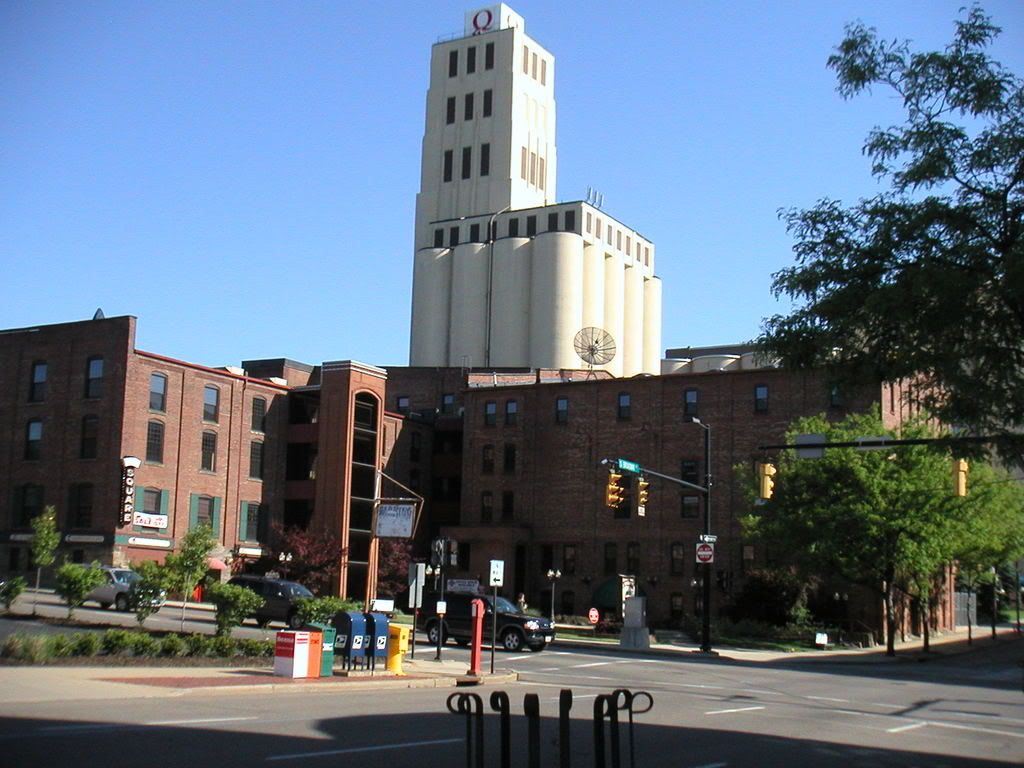
The Dispatch, which is all over the Akron U’s purchase of Quaker Square like beige on oatmeal, is on about misstatements by University Counsel Ted Mallo. You can read yesterday’s Dispatch online story or today’s print edition for the details.
The Beacon picks up the story on its front today, but with a decidedly less breathless tone. The sale, after all, was based on independent appraisals, not the auditor’s assessment which everyone (but the Dispatch) know is way less than anything we would normally call market value. Still, information explaining all that in the ABJ’s story raises some questions:
- The appraiser hired by the university who came up with the price said last night that the county auditor does not consider the value of such things as the Crowne Plaza name nor the historic nature of the property, converted in the mid-1970s from a grain elevator to a hotel with round rooms in the former silos.
Charles G. Snyder, who has offices in New Philadelphia and Uniontown, said the auditor also doesn't take into account the income a property produces.
Also, the price for almost any real-estate transaction is more than the county auditor's official valuation of the property.
Instead of muttering about abstract value numbers, the Dispatch could be focusing on a real question. Namely, should a university pay a premium for a functioning business when that premium doesn’t benefit the university? I’m not so sure they should, but it doesn’t sound like anything is going to change, whether or not Mallo returns to Columbus to clarify his All we can do now is watch the U try to make this a good investment.
Posted by Scott Piepho at Wednesday, August 22, 2007 1 comments
Philed under: Budget Fussing, Norka
Monday, August 20, 2007
The Dispatch's Odd Take on Quaker Square
Yesterday’s Dispatch ran troublingly tendentious story about the
The reporter tries to make the case that Something Is Wrong with the system by which universities acquire property, but appears not to have the facts to do so. Instead, the story contains dark-toned paragraphs which, once qualifiers are added, mean little. The rhythm of the piece is [1. Damning factoid] comma although [2. clarification that makes it not so damning really.]
As in:
- [1]The price for a fifth of those purchases was at a rate of at least $1 million an acre, although [2]state officials say such a measure holds little meaning for developed urban land.
Why yes, I could see how land with a ten story building on it might be a tad pricier than just land. Next,
- The historic downtown Akron structure -- converted in the mid-1970s from a grain elevator to a hotel featuring round rooms in the former silos -- will be converted again early next year into dorms for 382 students. [1]That's about $60,000 per student, although [2] the complex also includes offices, a banquet hall and 450 parking spaces.
And lots of retail and restaurant space that also could be converted to myriad uses. And by the way, how much “per student” does dorm space generally cost?
- The $22.7 million price, which matches the lower of the college's two appraisals, [1] is more than double the property's $9.8 million value for tax purposes.
While [2] the price for almost any real estate transaction is more than the county auditor's official valuation of the property, universities are paying on average about 63 percent more than the land's tax value.
Anyone who has tried to write messaging for a levy campaign knows this one. Taxable value is a fraction of actual market value. So if this was really a damning fact, maybe we would have some information about how much more than tax value urban property generally runs. We don’t. Throughout piece, the reporter fails to provide crucial facts that make the numbers meaningful. Instead, he shocks us with numbers than mean nothing without context.
Then we have this.
- The Quaker Square purchase, which initially angered Mayor Donald Plusquellic because he was kept in the dark, also benefits
"It should help us, yes," Brennan, owner of the 274-room Radisson Hotel Akron City Centre, told the Akron Beacon Journal. He said
*gasp* A David Brenner sighting. But perhaps the reporter should have noted that the same Akron Beacon Journal has reported that some rooms in the
It may or may not be true that our public universities are paying too much for property. If it’s true, the reporter should have dug up the facts to make the case. If it isn’t true, the story shouldn’t have run.
UPDATE: I don't have an online source to link, but Hannah News Service is reporting that the Controlling Board approved the purchase.Posted by Scott Piepho at Monday, August 20, 2007 1 comments
Philed under: Budget Fussing, Don't Worry About the Government, Mixed Media, Norka
Monday, July 09, 2007
Still Not Convinced About the Budget? Look Next Door.
During the recently completed budget process, there was a certain amount of grousing on the left -- the budget didn't go far enough on this or it didn't address that or it should have taken on the school funding system or this or that priority was misplaced. Not a lot of grousing, but it was there.
Anyone not yet convinced that Gov. Ted Strickland's handling of the budget process was masterful need only look to our immediate easterly neighbor to see what could have been. New Democratic Governor Ed Rendell and Republicans in the legislature have been deadlocked over the ambitious energy package embedded in Rendell's proposed budget. Now the government is in shutdown over the stalemate.
The last time Ohio had a budget shutdown, Jim Rhodes came back. Say no more.
EDITED for obvious reasons. You would think I'd learn not to trust my memory on these things.
Posted by Scott Piepho at Monday, July 09, 2007 1 comments
Philed under: Budget Fussing, Don't Worry About the Government
Thursday, July 05, 2007
Strickland Tackling School Funding; Meeting with Amendment Coalition.
Again, this is something I've alluded to but didn't have clearance to blog. Today the Beacon Journal's Dennis Willard writes that the Governor will meet with members of the coalition that came together to propose the school funding amendment as he starts the long process of forging a consensus on school funding reform.
I'm bracing myself for a spate of posts on the right crowing that Strickland doesn't have a school funding reform plan. Well, duh. The Governor's position has always been that he wants to lead to state toward school funding reform as opposed to imposing a plan on everyone. A process bringing all the parties together to reach consensus is by no means guaranteed to succeed, but proposing reform without consulting those parties is guaranteed to fail.
The budget was the first step. Strickland now has momentum and credibility to move forward with something more complex and permanent. At the same time, the stakeholder groups certainly have been made aware of their limitations. They didn't have the strength to get their proposal on the ballot and they certainly don't have the muscle to reform school funding all by themselves.
Personally, I couldn't be happier. My discomfort with the GIRFOF is not secret to even casual readers, but reform in nonetheless needed. We have a Governor who can actually lead and is willing to take on the challenge directly, as opposed to dishing it off on a blue ribbon panel. Finally, Akron appears to be in a decent place to weather a couple more years until reforms are in place.
Posted by Scott Piepho at Thursday, July 05, 2007 0 comments
Philed under: Academically Challenged, Budget Fussing, Laws and Sausages
Monday, July 02, 2007
Ed. Budget Recap
Where Have We Been?
The dust has pretty much settled regarding the budget. Governor Strickland did indeed veto the Special Ed Scholarships provision, a number of other education provisions and 38 line items in all. Reaction over the weekend from Jill, BSB and DailyKos, and a heads up pre-veto post from Len.
I’m still sifting through One item that didn’t get much attention regards the conflicts between traditional schools and charters. With some frequency schools have disputes about where a particular student is enrolled. One question is what to do about the money while that dispute is being resolved. Legislators tried to impose a new rule whereby the charter school, would get the money pending resolution of the dispute. The Governor vetoed that change, so the local school district does not have to forward the money to the charter until it is established that a student is actually enrolled there.
This budget process generally saw a school privatization movement that is increasingly aggressive and increasingly adept at generating grassroots interest. Traditional school advocates, on the other hand, continue to rely to heavily on “stakeholder” groups. Legislative committees heard from families speaking in favor of EdChoice, parochial schools fairly demanding to be paid by the state to educate special ed students and parents arguing against the governor’s proposed new restrictions on charter schools.
Now frankly, most of what happened in the General Assembly was wired. Enough of the majority is dedicated to the incremental erosion of the public school system that testimony was only intermittently relevant. Nonetheless, if the stakeholder groups want to continue having a stake to hold, they need to take their case to the people better than they have been doing.
As for the Governor, this has to be seen as a strong political victory for the Strickland Administration. The tactic from the start appeared to be to offer a budget modest in both spending and ambition to give the Governor some political breathing space. This was my impression and was consistent with the background I got.
The tactic worked. At the ODP Dinner, Strickland declared that he proposed a budget that kept spending to the lowest level in years and offered a huge tax cut and the General Assembly was so taken aback they had no choice but to pass it unanimously.
The only drama was whether the Governor would break the peace by using his line-item veto. In retrospect, we needn’t have worried. After all, the GA didn’t exactly pass the budget exactly as proposed. They took out restrictions on vouchers and charters and weren’t open to negotiating real reform to improve accountability. They added a new voucher proposal that was so bad it died in Committee in the last General Assembly. (Don’t listen to Husted singing laments for disabled kids – if he thought it was a good idea it would have past last year when they had a Governor who would sign it.)
Finally, bloggers did well. I was particularly pleased to see so many folks pick up on the special ed voucher provision after breaking it here. It was a case of overlapping interests for me – my organization was lobbying against it and I personally thought it was a bad idea. Anyway, thanks to Jill, Dave, the Plunderkids, BSB and anyone else I might have missed for playing ball on it.
Where We Going?
The budget was a two-year spending plan only. The Governor wisely did not tackle the thorny problem of education funding reform all at once. The DeRolph Court held that the funding formula is unconstitutional in part because it relies excessively on local property taxes. A funding fix will necessarily require some sort of tax swap – more state revenue and cuts in local property taxes. The budget took the first steps, but a full reform package would have been foolishly complex for the first budget of the new administration.
Nonetheless, the indications are that the Governor’s office remains committed to reforming the system. Word is that he is planning to meet with the ed groups. Meanwhile, with Schuring running for Congress, he will no doubt trot out his reform proposal again and get some interest from Republicans who want to give him credibility for his run.
The other side will no doubt keep working as well. This was at least the second time they tried special ed vouchers and, as I said, they generated some real grassroots issue. They will try again if only to embarrass Strickland into another easy-to-frame veto. Or they might try to package some targeted vouchers into an overall reform package, making it harder to oppose, and possibly even a good idea.
Whatever happens, this will not be summer vacation for education policy.
Posted by Scott Piepho at Monday, July 02, 2007 0 comments
Philed under: Academically Challenged, Budget Fussing, Stategery
Thursday, June 28, 2007
Budget Watch: Strickland Likely to Veto Special Ed. Vouchers
The budget passed its floor vote with a unanimous-minus-one vote last night. Still not definitive word from Strickland about special ed. vouchers, but word seems to be that he will veto. Last night Jill noted a quick mention in Openers that Strickland said he would "almost certainly" veto the program.
Then this morning, this in the Dispatch story:
- A key item likely to be excised is a proposed voucher test program for special-needs students. The program would offer about 8,000 students with individualized education programs up to $20,000 apiece toward the cost of private-school tuition.
It's entirely possible that at some point we will have a special ed vouchers bill. This one is as bad as a proposal can be -- basically a new middle class entitlement. Even voucher supporters should think twice about it.
Posted by Scott Piepho at Thursday, June 28, 2007 5 comments
Philed under: Academically Challenged, Budget Fussing, Laws and Sausages, Privateers
Wednesday, June 27, 2007
Budget Watch: Whither Special Ed. Scholarships?
More than anything, as the budget end game plays out, I'm looking for indications about what will happen to the Special Ed. vouchers proposal. On WKSU last night they aired a piece about Gov. Strickland's appearance before the Cleveland City Club yesterday. Kevin Niedermyer's intro says that Strickland and the GA have made enough compromises that he expect to "avoid any vetoes." Of course the piece also said that he would sign the budget last night, which was way off.
The Toledo Blade reports that the budget sailed through the conference committee with yet another unanimous vote. According to the Blade, the special ed. voucher proposal is still in the bill.
Dennis Willard writing in the ABJ today outlines the steps taken to rebalance the budget after the dip in projected tax revenue. He also notes some changes made to the new health insurance expansions, and some failed attempts to impose some order on school privatization schemes.
The Governor can line-item veto the program and, given the close split in the House, I doubt they can override. My concern is that he's so taken with the happy, shiny budget process that he won't want to buck the trend with a nasty veto. In a PD story about the budget, they quote him at the City Club predicting that the signing will be "joyous."
On the other hand, he set out his principle in his speech -- voucher programs, to the extent they are acceptable in compromise, must have some means test in them. The special ed. voucher program is universal, and will pay people who are already sending kids to private schools.
When I testified before the Senate Finance panel I went off script based on the testimony before me. I argued that once an education program is in place -- whether it's a brick-and-mortar school or a funding program or a virtual school, that program gains a constituency and
becomes extremely difficult to change or eliminate. The GA has taken no care in crafting this program and it's basically the Trojan Horse's nose under the tent.
Strickland should veto special ed. scholarships, Kum-ba-ya be damned.
Posted by Scott Piepho at Wednesday, June 27, 2007 3 comments
Philed under: Academically Challenged, Budget Fussing, Laws and Sausages
Wednesday, June 06, 2007
Budget Testifying
I was away from the blog world today because I was in Columbus testifying before the Senate Finance Committee about the Education budget. As is often true of a trip to C-Bus, I came back with many post ideas, most of which I probably won't get to. I'll try to get the basics up tomorrow, including an update about the Senate version of the budget bill, how the hearings went generally and what I had to say.
Meanwhile, between today and getting Carnival stuff set up, I'm way behind in responding to comments. It'll happen, just give me time.
Finally, keep an eye out for Plain Dealer education beat reporter Scott Stephens. He's likely to have some interesting GIRFOF news in the next day or two.
Posted by Scott Piepho at Wednesday, June 06, 2007 0 comments
Philed under: Academically Challenged, Budget Fussing, Democracy, Laws and Sausages
Tuesday, May 08, 2007
Issue 17 Down in Flames
Given that the issue faced no organized opposition and that the low off off off-election turnout should have tipped the issue to a good GOTV drive, this is an impressive asskicking:
From the BOE
Issue 17 - City of Akron, Income Tax
Vote For Not More Than 1
(WITH 153 OF 153 PRECINCTS COUNTED)
AGAINST THE INCOME TAX . . . . . . . . .11,489 . . . . 66.02
FOR THE INCOME TAX . . . . . . . . . . . . . . 5,913 . . . . 33.98
Bottom line: the mayor just didn't make the case. When friends to the left as well as the right vowed to vote against it, clearly the campaign was in trouble. For myself, I am just so bone tired of cities and states being held hostage by companies for handouts in the name of jobs, I just couldn't see fit on this one.
I think the case is strong for a tax about half the magnitude to replace lost state and Federal monies. I hope that's where the city goes.
Posted by Scott Piepho at Tuesday, May 08, 2007 1 comments
Philed under: Budget Fussing, Norka, Tax on Thingy