Showing posts with label Don't Worry About the Government. Show all posts

Monday, March 30, 2009

Why the Y Bridge?

Since Team Recall has put the decision to spend stimulus money on fencing around the Y Bridge, it's worth contemplating the decision to go with that particular project. First off, Grumpy Abe does some well taken grumping about the ABJ's coverage last Friday (toward the bottom of his post.) But regardless of whether the paper laid a sufficient foundation for "some call it wasteful" then, it's certainly the case that people are doing so now.

The comments in Ohio dot com track the usual criticisms of suicide fencing on bridges -- that it's not worth the money, that people would just find another way to do the deed. (Of course, this being the ohiodotcom comments section, they go way beyond that to the "just let them kill themselves" "why are we coddling these losers" and "Mayor Don's just doing this to keep his job." Vernon Dursley thinks these people need to find their souls. But then no one accused Plusquellec of driving anyone to jump off the bridge so probably we should just thank God for tender mercies.)

I'm all for rigorous cost-benefit analysis of public safety measures which the discussion of the Y Bridge is lacking. That is to say, can we spend $ 1.6 million where it would prevent more than (at most) one or two deaths a year. But contrary to the gripes of the comment trolls, there is evidence to suggest that fencing highly visible suicide bridges does prevent suicide. Studies (summarized here) indicate that fencing does stop suicides on bridges, without leading to increased suicides on other sites or by other means. Other studies indicate that would-be suicides who are "rescued" rarely continue to attempt.

Then there is the copycat effect. Suicide researchers worry that high-profile suicides that get reported in the media prompt rashes of other attempts. Someone doing the big splat off the Y Bridge will inevitably get media attention that they wouldn't by downing a pile of pills or monoxiding their garage.

Finally, preventing public suicide from a place like a well-travelled bridge also prevents untold psychological trauma on potential witnesses -- either of the leap above or the crater below.

Again, this is not to say that preventing suicides on the Y Bridge is the best use of the money. And running under all of this are questions about how the project fits with the stimulus program. It may well be that fencing the bridge is a particularly "shovel-ready" project.

Regardless, the evidence indicates that fencing the bridge will indeed save lives. We shouldn't pretend it's a trivial waste just because it fits with someone's favored political narrative.

Thursday, March 05, 2009

State Recoverydotcom Sites: How Blue They Are.

Researching yesterday's post about state recoverydotgov sites, I was curious about whether there is any pattern to party affiliation and putting up such a site. Since SocialGovernment proprietor Alexander Muir has already done a bunch of the legwork on the state sites, I asked him about it in his comments section. His project isn't about party quibbles so he politely declined to name the trend but did offer some useful resources.

Namely two maps. One from Recoverydotgov's national office showing which states have their own websites:


And one showing party affiliations of governors:

And he invited me to reach my own conclusions. Which would be that of the 16 states that have put up websites, only one - Missouri - none has a Republican governor.*

Republicans opposing the stimulus package was a principled stand. With all the cleavages on social issues and foreign policy, the one constant in Republican thought are the convictions that government spending is bad and tax cuts are the only effective economic strategy. I didn't say it was a sensible stand, but it is a principled one.

But while voting against stimulus may have been principled, petty acts of defiance to undermine it are not. The Obama administration has included transparency provisions in the stimulus legislation and is encouraging states to use tools on the internet to effectuate that transparency. Republican governors may think spending-based stimulus is a bad idea, but unless they are Limbaugh pods, they should want the money to be spent on actual things, rather than wasted. Democratic governors are trying to use the internet to that end; Republicans by and large are not.

And it's not just the admittedly chimeric goals of transparency and public participation they may be thwarting. There's also work to be done to protect their citizens. For example, Ohio Attorney General Richard Cordray has launched a public information campaign warning homeowners to beware of scam artists pretending to be part of another (Republican hated) Obama initiative, the housing market stabilization plan. It will be interesting to see how many Republican states fail to take that common-sense step.

Republican state officials who pretend the Obama initiatives have nothing to do with them don't simply serve the Limbaugh "hope he fails" agenda, they also misserve their constituents.

*Edited thanks to Anthony in comments.

Thursday, February 26, 2009

The Mayor Recall Begins Now . . . Okay, NOW.

For a variety of reasons -- some of them good -- I've been off the blog for another protracted period. And for a variety of reasons -- some of them good -- I'm still not ready to give all this up. I've found that when getting back into the blog, the best strategy is to take on some low-hanging fruit. Go after some person place or thing easy to criticize, deride, snark about.

So let's check in on Warner Mendenhall's effort to recall Akron Mayor Plusquellec.

This week, in conjunction with the Mayor's State of the City address, Mendenhall rolled out release 1.2 of the recall effort. Last November the Mendenhollers set up a (now nearly static) website and promise to work at recruiting volunteers. This week however many folks they have are supposedly beginning the petition effort. Warner robo-called to invite me to a meeting about the whole thing, but unfortunately I had some important dishes to wash.

Aside from the fundamental argument that the city is broke and therefore needs to spend another $160 grand on a special election, the fundamental silliness of all this is captured nicely by Mendenhall's response to the State of the City address itself:

    Mendenhall, who watched the speech on the Web, said Plusquellic addressed several partnerships but not the one with the community. He said the mayor doesn't listen to or solicit feedback from citizens, especially when it's critical of him.

    "We need to hear from people: 'What is the state of the city?'" he said. "It's not for the mayor to say. It's for the citizens to tell him."
O great Warner Mendenhall. How wiser you are than James Madison! Those foolish founding fathers thought that the executive addressing constituents about the state of the nation was a good enough to enshrine in the Constitution. Fie on their folly.

This sort of knee-jerk contrariansim has marked Mendenhall's political career -- particularly his running fire fight with the Mayor. He offers little other than the immediate objection to whatever Plusquellec has proposed. Well, that and sucking up to city employee unions. The recall group has offered some reasonable critiques, but are hard to take seriously packaged with this venom and goofiness.

Which is the real tragedy in all this. The city could use a serious minded critic of city government. One-party political environments rarely produce good government. (*cough* Cuyahoga County *cough*). That Akron has stayed afloat as long as it has without any serious threat to the power structure in itself speaks highly of that power structure. But it's far from perfect and legitimate loyal opposition would be welcome.

That Mendenhall has been able to maintain his practice as well as whatever power base he has through all his political adventures disproves the adage that you can't fight city hall. Unfortunately he has yet to demonstrate that he can fight city hall without acting a fool.

Sunday, September 07, 2008

The Jennifer Brunner Rorschach

Tell me what you think of Secretary of State Jennifer Brunner and I'll tell you your politics. If you love her, you are a mainstream Democrat. If you think she's well meaning but doesn't do enough to secure, you are a Dem, but farther out on the left wing. If she's a useful idiot duped by the ongoing Diebold/Rove conspiracy to steal elections, you are a Green (genus Fitrakis.) If you don't have much of an opinion one way or the other, you are somewhere in the middle of the spectrum and/or one of those wise people who doesn't pay attention to politics until about mid-October.

And if you gnash your teeth at the very mention of her name, you are a Republican.

The obvious explanation for the Brunner Rorschach is 2010 reapportionment. If Gov. Ted Strickland and Secretary Brunner retain their seats, Democrats will control the reapportionment board which will influence what the legislature looks like which will in turn determine who Congressional districts are drawn. That's important any decade, but assuming Ohio will lose two Congressional seats as projected, it's crucial. At her Akron Press Club appearance Thursday, Brunner acknowledged the importance of her seat to both sides and noted dryly "It becomes a little prickly sometimes."

Throughout her presentation and the Q&A after, Brunner cited the work she is doing to make voting easier and more reliable for Ohioans. Her office is turning out directives to Boards of Elections, in an attempt to offer what she calls a library of resources for a variety of contingencies. She's working to get voter rolls online so people can verify that their registration is up to date. She is requiring counties to have backup paper ballots in case machines go down or lines get too long (touchscreen machine voting routinely runs longer.) She's rolled out uniform poll worker training, in part to make sure workers across the state enforce rules consistently.

Again and again Brunner talks about working proactively to guarantee people the right to vote. Which offers a second explanation for why she vexes Republican so. Democrats and Republicans simply have different philosophies about how to govern voting. For Democrats, voting is a fundamental right that the government should take pains to guarantee, if not encourage. For Republicans, voting is a privilege to be earned by just following a few simple rules, dammit, and pulled out of reach of anyone who even looks like he might commit voter fraud.

It is again, easy to dismiss all this as simple politics. Historically Democrat's coalition have included more population segments susceptible to vote suppression -- primarily poor folks who have less job flexibility and minorities for whom voting is associated with a long history of intimidation (these are the sorts of voters you get when you are the elite

  • I forgot my camera, so a crappy image from my cell phone will have to do. As you can see, she spoke next to an open nuclear reactor.
  • She began the talk with an anecdote related to her that some professer told someone from Uganda that he was from Ohio and the Ugandan asked if that was where Blackwell was from, and "Isn't he the one who stole the election for Bush?" Her point was that Ohio shouldn't have election problems that make news halfway around the world.
  • Stolen Election Guy wasn't there, nor was his Republican counterpart, Rampant Voter Fraud Guy. At least they didn't ask questions, and the odds of either Guy sitting on his hands for an hour are at least as long as the odds of a valid Columbus Dispatch poll.
  • Notwithstanding that, Brunner talked quite a bit about security. She is trying to get rid of touchscreen machines because, among other things, they aren't secure. She's also getting rid of "sleepovers."
  • She's predicting an 80% turnout in November.
  • She lauds Summit Co. for "superior" vote security. She also noted that she has to break BoE ties and some in places -- again Summit -- the boards deadlock a lot.
As usual, the program will be rebroadcast on local public access. Keep an eye out. Brunner's not the most dynamic speaker, but the program was heavy on information.

Wednesday, July 02, 2008

Strickland's Education Forum Coming to Akron

Governor Ted Strickland has announced that one of his twelve planned "education forums" will be in Akron at North High School on July 23. The Governor has started a website, Conversations on Education to facilitate/publicize the listening tour. The url embedded on Ohio dot com doesn't seem to work for the website. You can try here or here.

The Governor has gotten grief for not fixing either the schools themselves or the school funding mess as of yet. It always seemed to me that any proposal would come after the midterm elections. First, because such a proposal takes time. The Governor committed to getting input, particularly from the business community. Being pretty much a pro-business D, that's what he would have done anyway, plus anyone paying attention to the GIRFOF mess knows that the effort was doomed as soon as the business community spoke out against it.

Also, any proposal prior to midterms becomes a political football. The R's would have to oppose it regardless of merit or risk handing the statehouse over to the D's. Which brings up the third factor -- once it became apparent that generic D's would do well in the midterm, Strickland's best bet is to wait until the November smoke clears to see what kind of General Assembly he has to work with. If, as hoped, D's take the House, he will get much more of what he wants.

I've had background conversations with various sources that pretty much confirm the above. And it's pretty well known that Strickland has been meeting with various stakeholder groups, including business groups.

The forums are another step in the process. How much will be gathering input and how much will be softening the ground for the eventual proposal remains to be seen. According to the website, things are organized around the six principles outlined in the State of the State address. You remember those, right? No? Well, here's a refresher:

    And I have developed six core principles that will guide our efforts to achieve that vision.

    First, we cannot address our education challenges without strengthening our commitment to public education. As a practical matter, the vast majority of Ohio children are and always will be educated in the public school system.

    Second, a modern education must be directly linked to economic prosperity. Ohio cannot thrive without understanding that world class schools will produce a talented workforce, and a talented workforce will attract and create jobs.

    Third, we need to identify the great strengths of our schools. There are features in our education system that the rest of the world seeks to emulate, and we must build on these triumphs.

    We excel internationally in our ability to foster creativity and innovation. These skills fuel a lifetime of success, especially in an evolving global economy.

    Ohio schools produced the minds that created Superman, with his fictional X-Ray vision, and the mind that invented the MRI, giving doctors the very real ability to painlessly view inside the human body. Ohioans are visionaries, but practical as well. It wasn’t long after a pair of Ohioans invented the airplane that another Ohioan invented the parachute.

    Our schools must teach students to think past the limits of what’s been done, and imagine what could be done.

    Fourth, our best teachers can show us what works best in the classroom. We need to consult them and follow their lead.

    Great teachers can be a resource not only for their students but for their fellow educators. We should support these teachers by giving them the freedom to stay in the classroom and still be rewarded for sharing their expertise with their peers. We lose a lot of new teachers – as many as half of all new teachers leave the profession in the first 5 years – but we can help keep these talented people by giving them better access to senior colleagues.

    Fifth, we must strive to develop a specific, personalized education program that identifies how each individual student learns and use the teaching methods appropriate to that student’s needs and abilities.

    The great educator and philosopher John Dewey described this idea many years ago. He wrote that we must shift “the center of gravity” in schools. It’s a “revolution, not unlike that introduced by Copernicus when the astronomical center shifted from the Earth to the sun. In this case, the child becomes the sun around which the appliances of education revolve.”

    And sixth, testing and assessment will continue to answer accountability questions. But their most important role will be to guide personalized and individualized education through a comprehensive and ongoing understanding of a student’s capabilities and weaknesses and growth in the educational process.

Not the list I would pick, but good enough to be going forward.

Wednesday, May 28, 2008

Strickland Appoints OSU Law Dean as Interem AG


Gov. Ted Strickland announced today that he is appointing Nancy Hardin Rodgers, currently Dean of the Ohio State University Moritz School of Law, to be interim Attorney General. According to both the press release and the press conference, Dean Rodgers will take a temporary leave of absence from Moritz and does not intend to run for the unexpired term.

Resources:

Dean Rodgers' bio page, including a link to her curriculum vitae (pdf) on the Moritz website.

Dean Rodgers on Wikipedia (already updated of course.)

Governor's statement.

Good career rundown from Jeff. I would add that in addition to serving on the Executive Committee of the American Association of Law Schools, she is also the immediate past President.

I briefly interviewed a source who works in law school administration (grin). She says that Dean Rodgers is widely admired and highly accomplished. She also said that despite a soft-spoken demeanor, she has a sufficiently thick skin to be effective as a law school dean. In many ways she is the AntiDann.

I'd agree with Jeff's assessment that she is a solid choice, though labeling it "safe" may include some connotations I don't necessarily agree with. Strickland has deftly threaded the needle. He picked someone with extensive administrative experience, but without political ambition. In other words, someone well poised to assume the role of cleaner.

What the office needs now is someone who will root out the rotten parts of the office, but with enough care and precision that she doesn't gut the workforce. The citizens of Ohio are best served by someone who will reform the office objectively, without being constrained by political considerations. What the office doesn't need is someone scrambling to put his or her own policy stamp on prior to the election. In all Dean Rodgers appears a good fit.

Friday, May 09, 2008

Marc's Mess: We Have to Wait for Fifth Street

Despite the promise in the letter to serial screwup AG Marc Dann, articles of impeachment will be some time in coming. The House Republicans have Rep. Bill Batchelder looking into it and some comments from the Dem leadership reported in the Dispatch sound equivocal. Bloggers on the left and right are getting bent about backtracking.

Since summer is approaching, the World Series of Poker will start up soon. It's a good a time as any to review a couple truths about Texas Hold 'Em. If you bet big based on your hole cards and your opponent folds, the hand is over. If you bet big and your opponent calls, the hand goes on. If your opponent continues to call, the hand will go on until the dealer lays down the fifth common card ("The River," or "Fifth Street.")

And if you've been called on a big bet, you should think twice about betting big again until you have an idea what your opponent has.

As it is in poker, so it is in Marc's Mess. When Strickland bet big after the Espy report he wasn't exactly bluffing. He has a strong hand. The report outlines improprieties that led not only to a hostile environment for women, but a hostile environment for anyone with an unblackened soul. Dann meanwhile looks like he's holding about a nine high. But you never know. . .

While it offers a solid starting hand, the Espy report only begins to build the case against the AG himself. No pair of aces here. Thanks to his throwing Ed Simpson under the bus, Dann has a colorable argument that he was negligent in failing to prevent the excesses of his cronies, as opposed to actively complicit in those excesses. Based on that report alone, impeachment is a hard sell. Notwithstanding Connie Schultz's argument, the legislature is unlikely to embrace the standard that sex with a subordinate is per se impeachable. Too many legislators, erm, know someone who has gone there before.

The more salable candidates for a bill of impeachment run along two lines. The first is that Dann was far more in his friends' misdeeds than he's admitted. Somewhere in the blizzard of paperwork and subsequent reports is the allegation that complaints against Gutierrez were forwarded to Dann's office and pretty much disappeared into a void there. Mix an ongoing effort to violate workplace discrimination laws (even where those laws aren't technically criminal) and/or to cover up those violations along with everything else, and this starts to look more impeachable. Similarly, if evidence surfaces that Dann knew of Gutierrez's penchant for playing bumper cars with state vehicles and did nothing, we can sell that to the Legislature.

The second line of inquiry is whether Dann lied under oath when interviewed by Espy. In at least two spots, I am suspicious. First is the question of whether he lied about Jessica Utovich spending the night at the now-infamous condo1. To review, Dann initially says he doesn't remember, then in a subsequent sworn statement, amends that to say that he now remembers she did spend a night or two, though at that time couched it in terms that still preserved deniability about the affair.

It's all well and good for a witness to say he doesn't remember most of the time. Most of the time, that will work even if not actually true. And if it is true that Utovich only stayed the night a couple of times because it was late, it's at least conceivable that Dann wouldn't remember. But if she spent the night because that's when they engaged in the inappropriate part of their "inappropriate relationship," he certainly would remember that. To say he doesn't remember at that point puts us in Steve Martin territory.

A second possibility is that he lied in minimizing his involvement with the Gutierrez hire. I've outlined that case previously.

At this point we have limited information, but probably not enough to say unequivocally that Dann's transgressions are or should be impeachable. We need a few more cards on the table. We need, for instance, to hear from the Shiny-Faced Scheduler herself, and under oath. We need to drag Ed Simpson out from under the bus and see what he has to say. Open questions remain not only about what people know but also whether they are willing to divulge it. And until there are a few more cards under the table, an elected official speaking without reservation about impeachment does so recklessly.

Watching poker offers, among other things, an entertaining way to study how people make decisions based on incomplete information. So does the Dann drama.

1ModernEsquire is right to a point when he says that a deponent has the ability to review a deposition, but that's only part of the story. First, one generally reviews the transcript for errors in transcription. You can't change the record, only correct how it was recorded. Second, if Utovich spent the night on inappropriate-relationship-related business, his second statement suggesting that she did so only because it was late and she was there on actual AG business doesn't cure the deception, it perpetuates it.

Image courtesy of Wikimedia Commons.

Tuesday, May 06, 2008

Dann Replacement: Jeff Has the Cordray Scenario

Jeff Coryell reports hearing the following scenario:

    * Strickland's Chief Legal Counsel Kent Markus will be appointed interim Attorney General following Dann's resignation or removal but will not run for election in November;

    * Treasurer Rich Cordray will run for Attorney General in the special election without giving up his current post; and,

    * If Cordray wins the special election he will then give up his seat and Strickland will appoint a replacement, presumably a high-profile county treasurer and/or an officeholder with statewide campaign experience. From my northeast Ohio perspective, Cuyahoga County Jim Rokakis and Lt. Gov. Lee Fisher come immediately to mind but there are many others who would fit the bill.

That is consistent with the rumor I've heard, reported here. It's also amazingly good politics as Cordray is an unassailably solid candidate and the Dems risk only one seat instead of two. The only unfortunate aspects are A) that Cordray won't have six months or so to clean up Marc's Mess and B) Subodh isn't part of the mix.

Monday, March 31, 2008

Fingerhut's Soft Sell

Chancellor Eric Fingerhut of the The University System of Ohio delivered his Strategic Plan as scheduled today. The result is a painfully cautious document with many laudable goals (increased enrollment, more STEM degrees, improved quality) but few of the hard choices necessary to achieve them. You can find the Plan, along with a separate downloadable Executive Summary at the U System website.

As one example, the Plan spends considerable time examining the situation here in Northeast Ohio. We get an accurate, unblinking view of the landscape:

    Yet questions about the missions of the distinct
    universities do arise in Northeast Ohio. The reason
    is plain – the state has four public universities in
    four contiguous counties (Cleveland State in
    Cuyahoga, Kent State in Portage, the University of
    Akron in Summit and Youngstown State in
    Mahoning), plus one of the last free standing
    medical schools in the country, the Northeastern
    Ohio Universities College of Medicine
    (NEOUCOM), in a region that has seen its overall
    share of the state’s population decline over the last
    several decades. The close proximity and the lack of
    population growth have made the schools
    intensely competitive, a competition which has not
    served the best interest of the state or the region.

Acknowledgment that no on can be happy with the current situation:
    Had we started with a blank slate, we would not
    have drawn so many competing institutions in
    such close proximity to each other.

And a firm, decisive plan to . . . keep talking about it:
    To that end, the Chancellor will
    convene a public session of the trustees of the
    four public universities and NEOUCOM at least
    annually to review the progress toward
    improving quality, increasing mission differentiation,
    increasing collaboration, increasing the
    contribution of the institutions to the regional and
    state economy, and decreasing competition
    among the institutions.

The report as a whole pretty much follows that pattern. We now have goals and a promise that Chancellor Fingerhut will follow up on those goals, but as yet only faint suggestions that the Chancellor or the Governor are contemplating bringing any big wood into the game.

Given Ohio's historically entropic universe of public institutions, simply assembling a document suggesting a single vision is itself an impressive accomplishment. This report would not have been possible were it not for the Governor's success in organizing a single system under an executive appointed Chancellor. Still, assembling the Strategic Plan is a simple matter compared to actually implementing it. One measure of how difficult this will be is the calculatedly inoffensive tone of the document. It's a soft sell. Now we see who buys in.

Friday, February 22, 2008

BREAKING: Enzyte Won't Really Enlarge Your Pen1s

Shocking news from Cincinnati.

The continued viability of Enzyte (the once-a-day supplement for natural male enhancement) has a brand has always been something of a mystery. Obviously, the stuff had to be fake. Yet the parent company not only survived, but had the money to run the brilliant (if fraudulent) "Smiling Bob" ads seemingly during every ESPN commercial break. And they famously sponsored:


Their own NASCAR entry.

Turns out, the whole thing, was not only a consumer fraud, but was an ongoing credit card scam:

    When customers ordered a product, the company's goal was to keep charging their credit cards for as long as possible, Teegarden said.

    He said first-time customers were automatically enrolled in a "continuity program" that sent Enzyte to their homes every month and charged their credit cards without authorization.

    "Without continuity, the company wouldn't exist," he said. "It was the sole profit of the business."

    If customers complained, he said, employees were instructed to "make it as difficult as possible" for them to get their money back. In some cases, Teegarden said, Warshak required customers to produce a notarized statement from a doctor certifying that Enzyte did not work.

And what may go down as the best line of trial testimony ever:
    "He said it was extremely unlikely someone would get anything notarized saying they had a small penis," Teegarden said.
As a scam it was brilliantly audacious. This wasn't just something from a fly-by-night web-based operation, this was a real company! With ads on ESPN! And a presence in NASCAR!! All designed to make it look like the product must have some value or it just couldn't maintain all that presence.

Which leads to a serious point. Apparently the Feds have been after the company -- Berkeley Pharmaceuticals -- and founder Steve Warshak for a couple of years. They were able to make the case primarily by turning one of Warshak's top executives. Why, we must ask ourselves, is it so hard to make a case when the fraud is so obvious? Could it have anything to do with the anti-regulatory fervor of the current administration and the immediate past Congress?

The Berkeley Pharmaceuticals verdict comes one day after the Supreme Court ruled that states cannot offer stronger consumer protections if Federal law regulates an industry. It's easy to make jokes about Bob's wife smiling no more, but this could be a sign of something significantly less funny.

Friday, November 09, 2007

Fingerhut: NEOUCOM Rootstown Campus Will Stay

In his most strongly worded statement on the subject, today University System Chancellor Eric Fingerhut stated today before the Akron Press Club that the Rootstown campus of the Northeastern Ohio Universities College of Medicine is an "important institution" that will remain in place. The status of NEOUCOM's current facility in Rootstown has been the subject of speculation for some time. Fingerhut's statement appeared aimed in part at resolving those questions.

Fingerhut was in town to discuss the University System of Ohio. The System is working on a ten-year Master Plan to reform the system to encourage collaboration and to improve efficiency and capacity. Since talk of possible mergers broke, the Chancellor has been saying that all ideas are subject to discussion.

As he began his speech, Fingerhut aknowledged "the kangaroo in the room" and assured the audience that "Zippy is safe." Previewing the end point of the speech, he said that the goal is to expand the both the teaching and research capacities of schools in the University System. The overall goal is to increase the number of students in the university system by 230,000 in the next ten years. At the same time, Fingerhut spoke of individual schools "thinking in a collaborative way" instead of competing with one another.

Aside from the reassurances about Rootstown, Fingerhut offered little specific information about where the process might be going. He said that Ohio will not copy a university system model from another state, but will "create a new prototype." He also said Ohio will not create a new bureaucracy and will not "abandon the commitment to local governance."

With regard to NEOUCOM, Fingerhut said that students at the Rootstown school might benefit from expanded opportunities to study in Akron or Cleveland, but that the Rootstown facility will remain.

Referring to discussions of possible mergers, Fingerhut said that they are examining every idea as it is advanced. The philosophy of the university system is to "stop putting individual institutions and cities first." When asked why mergers are necessary, he stated that he doesn't know that they are, but that all options are being considered. He also suggested that mergers should be a last resort.

Fingerhut spoke a great deal about the importance of state universities attracting more research grants, particularly in engineering and medicine. At the same time, he said that every university must provide a comprehensive education, including liberal arts, so no university will be without humanities and social sciences departments.

The University System is now posting components of the Master Plan as they are developed. The Master Plan Forum also includes fields to allow users to leave comments. The deadline for submitting the Master Plan to the Governor and General Assembly is March 31, 2008.

Friday, September 28, 2007

Building Inspectors Inspected

The Akron Building Department has been dinged by an Ohio oversight agency for failing to comply with rules:

    Akron's building department has failed to adhere to the rules and procedures established by the Ohio Board of Building Standards.

    And four department employees will be advised Monday of a move to revoke their certifications as inspectors.

    That was the finding of a voluminous report released today by the Ohio Department of Commerce that resulted from an investigation into complaints against the city's building department and its suspended chief officer, Greg Burgoon.

At the mayoral primary debate, Joe Finley cited a recent Plusquellec harague at the building department as Exhibit A. He alleged that the interim building inspector had resigned as a result (as it turns out, untrue.) Somehow he had a recording of the incident and his spokeslawyer Warner Mendenhall was handing out CDs in the lobby after the event. Mendenhall said that

Plusquellec's response was to own it proudly. He said the inspection department wasn't doing the job and damn yes he got after them. Not that he needs validation, but this is big time validation. And how bad would Finley look now if he had pulled off the upset and was now against the inevitable Republican as Independent challenger?

Monday, August 20, 2007

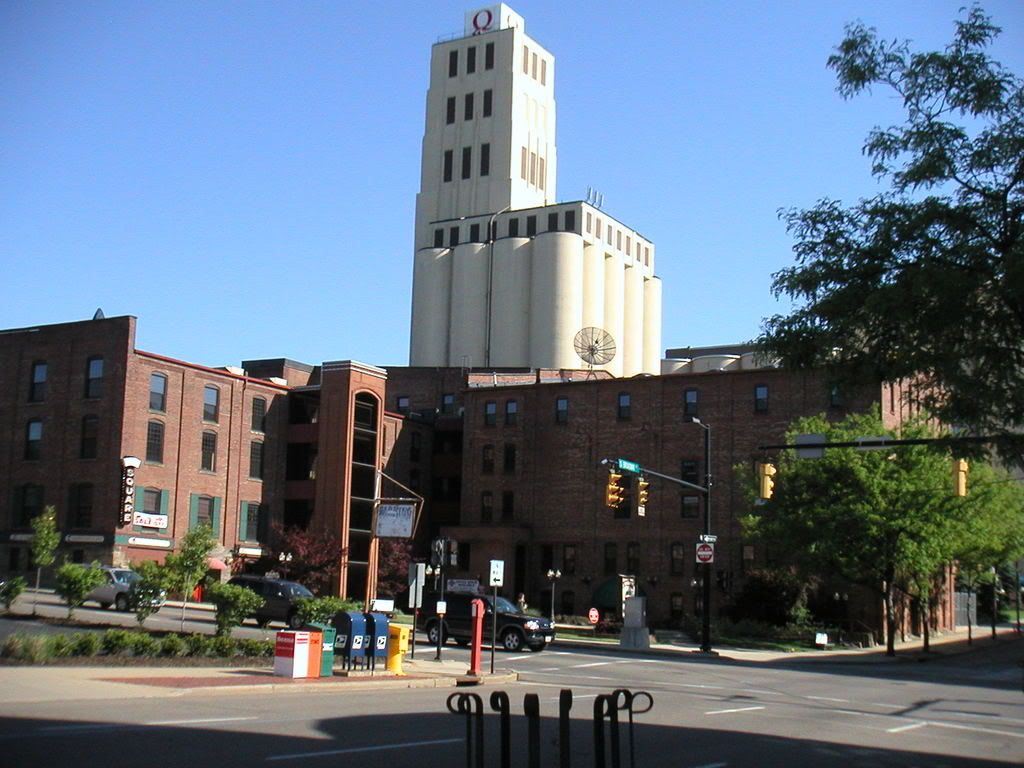
The Dispatch's Odd Take on Quaker Square

Yesterday’s Dispatch ran troublingly tendentious story about the University of Akron’s impending purchase of the Quaker Square property. While I haven’t been much impressed with Beacon’s reporting on the issue, the Dispatch story makes the ABJ’s coverage look Pulitzer-worthy by comparison

The reporter tries to make the case that Something Is Wrong with the system by which universities acquire property, but appears not to have the facts to do so. Instead, the story contains dark-toned paragraphs which, once qualifiers are added, mean little. The rhythm of the piece is [1. Damning factoid] comma although [2. clarification that makes it not so damning really.]
As in:

    [1]The price for a fifth of those purchases was at a rate of at least $1 million an acre, although [2]state officials say such a measure holds little meaning for developed urban land.

Why yes, I could see how land with a ten story building on it might be a tad pricier than just land. Next,

    The historic downtown Akron structure -- converted in the mid-1970s from a grain elevator to a hotel featuring round rooms in the former silos -- will be converted again early next year into dorms for 382 students. [1]That's about $60,000 per student, although [2] the complex also includes offices, a banquet hall and 450 parking spaces.

And lots of retail and restaurant space that also could be converted to myriad uses. And by the way, how much “per student” does dorm space generally cost?

    The $22.7 million price, which matches the lower of the college's two appraisals, [1] is more than double the property's $9.8 million value for tax purposes.

    While [2] the price for almost any real estate transaction is more than the county auditor's official valuation of the property, universities are paying on average about 63 percent more than the land's tax value.

Anyone who has tried to write messaging for a levy campaign knows this one. Taxable value is a fraction of actual market value. So if this was really a damning fact, maybe we would have some information about how much more than tax value urban property generally runs. We don’t. Throughout piece, the reporter fails to provide crucial facts that make the numbers meaningful. Instead, he shocks us with numbers than mean nothing without context.

Then we have this.

    The Quaker Square purchase, which initially angered Mayor Donald Plusquellic because he was kept in the dark, also benefits Akron industrialist and charter-school operator David Brennan, who would own the city's only downtown hotel.

    "It should help us, yes," Brennan, owner of the 274-room Radisson Hotel Akron City Centre, told the Akron Beacon Journal. He said Akron doesn't need a second downtown hotel.

*gasp* A David Brenner sighting. But perhaps the reporter should have noted that the same Akron Beacon Journal has reported that some rooms in the Quaker Square hotel will remain hotel rooms and that the city is in the process of finding a developer for a new hotel. Kind of an important additional fact.

It may or may not be true that our public universities are paying too much for property. If it’s true, the reporter should have dug up the facts to make the case. If it isn’t true, the story shouldn’t have run.

UPDATE: I don't have an online source to link, but Hannah News Service is reporting that the Controlling Board approved the purchase.

Thursday, August 16, 2007

Richard Cordray Coming to Akron Tomorrow

State Treasurer Richard Cordray has been touring the state promoting his two favorite ideas -- economic development and financial literacy. He comes to Akron tomorrow. From the presser:

    Economic Development
    9:15-10:15 a.m. Ellet IGA Grocery New FirestonePark Store, 1028 Hammel Street.

    Ohio Treasurer Richard Cordray is reviving the state’s interest rate reduction program for small businesses. Right now the Treasury has nearly $500 million to invest in Ohio small businesses through the Linked Deposit program, which can help borrowers save up to three percent on their loan.

    Treasurer Cordray will be stopping at Ellet Grocery in Akron as part of a statewide tour of Ohio small businesses. The grocery is a recent participant of the Treasurer Cordray’s Linked Deposit program and serves as a model for other Ohio small businesses. Cordray will be available to discuss the economics behind the program and his intentions for its success.

    Women & Money
    12:15-12:45 University of Akron, 302 Buchtel Common

    Through the past decade women have surged as leaders in business, at home and in the consumer marketplace. According to a study by the Center for Women’s Business Research, majority women-owned businesses have continued to grow at nearly two times the rate of all businesses. In Ohio, there are an estimated 350,369 privately-held, majority women-owned businesses, generating nearly $58 billion in sales.

    With this in mind, Ohio Treasurer Richard Cordray brings his “Women & Money” conference to Akron, offering free seminars focusing on subjects such as budgeting, homeownership, investing and retirement planning. The event will bring hundreds of Akron area women together to examine financial issues affecting everyone. Guided by financial planning experts, the day-long program will explore common errors, solutions and unique ideas.

I have family plans (of course) so no coverage.

Monday, July 09, 2007

Still Not Convinced About the Budget? Look Next Door.

During the recently completed budget process, there was a certain amount of grousing on the left -- the budget didn't go far enough on this or it didn't address that or it should have taken on the school funding system or this or that priority was misplaced. Not a lot of grousing, but it was there.

Anyone not yet convinced that Gov. Ted Strickland's handling of the budget process was masterful need only look to our immediate easterly neighbor to see what could have been. New Democratic Governor Ed Rendell and Republicans in the legislature have been deadlocked over the ambitious energy package embedded in Rendell's proposed budget. Now the government is in shutdown over the stalemate.

The last time Ohio had a budget shutdown, Jim Rhodes came back. Say no more.

EDITED for obvious reasons. You would think I'd learn not to trust my memory on these things.

Thursday, April 26, 2007

The State Board of Education Wants Your Opinions about Our Schools

The State Board of Ed is looking for public input regarding the Achieve, Inc. report on Ohio Schools. The Department of Ed is compiling a report that the Board will use in its June retreat to help determine the direction of Ohio education policy. They've been conducting a set of regional workshops that, unfortunately, I didn't get wind of until now when they are pretty much done (Akron's was last night.) Happily, they are also conducting an online survey and have tools to let people submit written comments online.

For a bit of background, the Board commissioned a pair of bipartisan policy consulting groups -- Achieve and McKinsey & Co. -- to conduct a comprehensive study of Ohio schools. Their report recommends fundamental changes that touch every area of public education policy -- curriculum, testing, school management, finance, it's all there. The subject ares considered are summarized in this slide from ODE's PowerPoint on the study.


You can read either the study or summaries on the Website. Also, the Plain Dealer ran a solidly reported story on the report when it came out.

ODE and the Board are serious about getting citizen input. Unfortunately, the effort has been publicized mainly through stakeholders. If you want them to hear citizen input, it's up to you. Get online and take the survey, or just submit comments.

I, of course, have my opinions which the Department heard at yesterday's meeting. I have a blogging punchlist for the next couple of days. If I get through it, I may post some thoughts on the report as well.

Wednesday, April 18, 2007

Ohio Legislative Committees; Let the Sun Shine In [UPDATED].

Eric’s comment in the first post about the budget hearings re-raises a good point. Sadly, a citizen – even an engaged and tech-savvy citizen – can do little to keep track of how our General Assembly deliberates. Most of the real legislative work is done in committees. That’s where the body takes what testimony it will in support or opposition to a bill, it’s where most of the amendments are attached and it’s where the majority of bills whither and die.

Yet, for all their importance, committee hearings in Ohio generate little in the way of a permanent record. On the Federal level, every hearing of every committee is transcribed and, except for the few that get classified, the transcripts are available at your nearest Government Documents Repository. Not so in Ohio. Our committees record what witnesses they heard from and the results of any votes taken. That’s it. And if the hearing minutes are posted on line, I can’t find them.

So we have to rely on our friends in the media. That, needless to say, has limited utility. Committee hearings require a reporter to sit for a day, hoping something interesting happens. Last week’s hearings went well into the evening most nights. From what I heard, most of the best pro-public ed. speakers didn’t get to the stand until reporters had left to file stories.

If all this sounds fuzzily familiar, it’s because I posted a few weeks ago about a bill freshman proposed by Rep. Steve Dyer (D-Green). The bill is now posted – it’s H.B. 147. It would require, that “[t]he minutes shall, at a minimum, consist of a paraphrased summary of all testimony and exhibits presented, all discussion had, and each question asked and answer given during the meeting.” The bill also gives the committee the discretion to prepare a transcript of the hearing. Best of all, Rep. Dyer hasn’t forgotten his blogger friends:

    When the minutes are available for public inspection, the secretary shall file them with the clerk. The clerk shall post the minutes on the general assembly's web site in a manner that links each portion of the minutes that is relevant to a particular bill or resolution to the legislative history of that bill or resolution.
Unfortunately, no one I talk to gives Rep. Dyer’s bill much chance of getting a hearing. It hasn’t yet been assigned to a committee, so I can’t even tell you who to bitch to. On the other hand, Rep. Jennifer Garrison’s attempt last year to require the House to post floor votes in an online, searchable database did eventually result in something close, and better than what we had before. As long as we have some members who are interested in open government,

CORRECTED to add the last link, but see the discussion in comments -- the vote function appears to be buggy. And since it's a Java error, I tried it in both Firefox and IE -- still no dice.

Thursday, April 05, 2007

Rep. Steve Dyer (D-Green) Proposes Sunshine in Statehouse Committee Hearings

As reported in OPENERS, Rep. Steve Dyer has proposed a bill that would require the General Assembly to prepare and file a record of each committee hearing. On the Federal level, every committee hearing has been transcribed, pretty much forever. On the state level, there is nothing of the sort. The Committee reports record only who testified and vote outcomes, if any.

I spoke to Rep. Dyer at the AdNEO roll-out and he mentioned the bill to me. He's pretty proud of the idea and rightly so. Unfortunately, as OPENERS notes, it's the sort of bill that journalists, but most legislators would just as soon not even talk about. Attorneys also wouldn't mind it, as it would provide some legislative history when trying to argue what the GA intended by a particular bit of statutory language. Activists would like it because it illuminates the process more and provides information about what information was presented to a committee that may have persuaded it to vote one way or another.

And needless to say, bloggers would like it. I asked Rep. Dyer if he envisioned an online searchable database and he said absolutely.

At the end of last year the netroots started to band together to generate interest in a bill Jennifer Garrison (D-Marietta) had proposed to compel the legislature to create a searchable database for floor votes. The end of the session ended the effort, but it would be great if we could revive it to support this.

BTW, the bill isn't up yet online. I'll update when it is.

Oh Yes. There Will Be Blogswarm.


JMZ first noticed a piece by Matt Naugle on Right Angle Blog in which he posts screen shots from the FaceBook page of John Brunner, the son Secretary of State Jennifer Brunner. The photos are pretty typical of the stupid stuff college kids post on their pages – chemical abuse and sexual exhibitionism. I wouldn’t be too happy about it if it were my kid. On the other hand, if a college sophomore can’t act sophomoric, who can?

For those of you who don’t venture into the blogoverse much beyond the pages, Matt Naugle is a front-pager on Right Angle Blog, a once-respectable conservative blog that moved to a community format and was quickly overrun by mouth-breathing freepers. Matt first rose to, well, whatever he has risen to, as the campaign blogger for J. Ken Blackwell. When Blackwell ranted that “Democrats believe that government is God and God is not,” Naugle’s brilliant defense began “THERE IS NOTHING TO APOLOGIZE FOR!” And so it generally goes when Naugle has a POINT to make.

So what, you may wonder, does John Brunner’s college foolishness have to do with Matt Naugle? The answer should be “nothing.” But to Naugle and other practitioners of politics by character assassination, the misbehavior of the son means . . . something. I was put off by the initial decision to post, but Naugle’s subsequent post is genuinely revolting.

Jill got an email conversation going and posted a fine rant against the RAB post. Echo posts have appeared so far on Silent Majority and Buckeye State. Matt has now responded. He makes some halfway-decent points about the younger Brunner being an adult and touting himself as having worked on his mother’s campaign. He also makes some silly points along the “They done it first!” lines. On this, remember that uber-conservative Rush Limbaugh crossed the line in ’93 when he called Chelsea Clinton “the White House dog” on national TV, then lied about it. Anyone want to pre-date that, be my guest.

Naugle also makes a genuinely incoherent point about the Buckeye State post, but when Jerid and Naugle start going at it, I’m inclined to make them both sit in a corner.

All well and good so far, but then Naugle drops this: “I will add that I believe John's Facebook profile is fair game, and it speaks volumes about the type of parents Rick and Jennifer Brunner were. But I leave it to you to make up your own mind.”

*Gurhk*

Yes. He really did say that.

Today on 90.3’s TSOI the panelists were talking about the court fight between Brunner and Bennett over the latter’s seat on the Cuy. Co. Board of Elections. While that was on, a thought occurred to me. Like much of the ’06 election cycle, Brunner’s campaign was about competence. It was about doing the best job for the citizens of Ohio regardless of party or ideology. Republicans lost that contest, in large part because too many on their ticket remained fixated on ideology.

I think Bennett has picked this fight in part on both grounds. On the one hand, stepping down would admit that Brunner is right about his lack of competence. On the other, by constantly beating the drum that Brunner is being partisan, Bennett is once again trying to convince voters that party should trump competence.

And so has Naugle. His point apparently is that Jennifer Brunner is a bad Secretary of State because her son is a knucklehead. Conservatives wonder out loud why they are sucking wind in polling here (thanks to Jill for steering me to that link before any of this started.) This is it. They keep at these absurdly partisan, nit-picky attacks instead of working on how to make government work. People were sick of it last November and show no signs of warming up to it now.

But maybe I’m wrong. Maybe Naugle has the bones of a winning campaign theme for ’08:
e will judge worth solely by personal decorum

    We will judge your worth based solely on your personal decorum.
    And that of your family, staff, co-workers and supporters.
    We are the Republican Party.
    You are not good enough, but vote for us anyway.
I will add that I think Naugle’s post speaks volumes about what an insufferable prig he is. But I leave it to you to make up your own mind.

Friday, March 23, 2007

Budget Bill Introduced

House Bill 119. It was actually introduced earlier this week, but you may notice I'm a bit behind. Legislative Services has a Bill Analysis up already. The bill is currently sponsored only by Matthew Dolan (R-Columbus), the chair of the Finance Committee. Dolan was one of the go-to State of State Adress bashers, but concentrated his criticism on too much spending. Since then Repubs have been scrambling to find a way to criticize the budget as proposed without actually saying that the Governor isn't spending enough.

On the other hand, Speaker Jon Husted made some friendly noises about, presumably about the spending part of the budget in the PD earlier this week.